How to Solve Sequence Problems on the SSAT Upper Level
To solve sequence problems on the SSAT Upper Level, you first identify the sequence type using a step-by-step decision method, then apply the matching rule. The most common mistake students make is jumping straight into calculation without identifying the type — which leads to wasted time and wrong answers.
The short answer: SSAT Upper Level sequence problems come in six types: arithmetic, geometric, Fibonacci, exponent-based, mixed rule, and repeating (symbolic). Work through a short checklist to identify the type: look to see if the question says “repeating.” If it doesn’t, check if the differences are equal (arithmetic), check if the ratios are equal (geometric), then look for Fibonacci patterns, perfect squares or cubes. Once the type is identified, solving is fast. The SSAT specifically likes to disguise repeating sequences as geometric ones — knowing how to spot that trap is one of the most reliable shortcuts in Chapter 6 of Hacking the SSAT Upper Level Math.
Terms are perfect squares, perfect cubes, or a variation of them. The giveaway: differences between terms are consecutive odd integers (which signals squares), or terms look familiar from the power charts.
Example: 1, 4, 9, 16, 25… → these are \( 1^2, 2^2, 3^2, 4^2, 5^2 \). Perfect squares.
This is exactly why having the power charts memorized matters — you recognize exponent-based sequences on sight instead of having to work them out.
Mixed Rule Sequences
Two steps are applied to get from one term to the next. Usually involves multiplying and then adding or subtracting. These require trial and error, but the other types above should all be ruled out first.
Example: 3, 8, 15, 24, 35… → differences are 5, 7, 9, 11 (consecutive odd integers, so we are working with squares, but shifted). Rule turns out to be \( A_n = n^2 – 1 \).
Repeating (Symbolic) Sequences
A fixed set of items — numbers, colors, shapes, words — cycles in order. These are sometimes called symbolic sequences. The solving method is completely different from the others: you use division and the remainder.
Example: Black, Blue, Green, Blue, Red, White, Purple… is a repeating sequence. Find the 59th term.
This is the type the SSAT most loves to disguise. A sequence like 2, 4, 8, 16, 32… looks geometric — but if the problem says it’s repeating, you treat it as symbolic and use the remainder method.
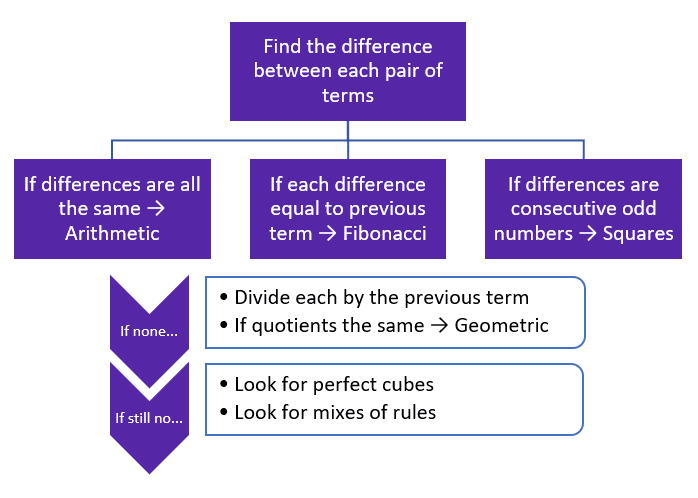
The Decision Flowchart
First, look to see if the questions uses the phrase “repeating sequence.” If it doesn’t, move through this flowchart to find the type of sequence it is.
Work through the steps in order — there’s no need to keep going once you’ve found the match.
Step 1 — Check for repeating. Does the problem describe a cycle that restarts? Use the remainder method.
Step 2 — Check the differences. Subtract each term from the next. If the differences are all equal, it’s arithmetic. Stop here.
Step 3 — Check the ratios. Divide each term by the previous one. If the ratios are all equal, it’s geometric. Stop here.
Step 4 — Check for Fibonacci. Are the differences equal to the previous term? If yes, it’s a Fibonacci sequence. Stop here.
Step 5 — Check for squares or cubes. Do the terms appear in the perfect squares or perfect cubes lists? Do the differences between terms form consecutive odd integers? If yes, it’s an exponent-based sequence. Stop here.
Step 6 — Try mixed rules. Does multiplying by a constant and then adding or subtracting produce the next term? If yes, it’s a mixed rule sequence.
If you’re working through any SSAT math problem and a sequence doesn’t immediately look familiar, this checklist gets you there without guessing.
Fully Worked Sample Problem: The Repeating Sequence Trap
This is the problem type that catches the most students — and the one where knowing the method pays off the most.
Worked Sample Problem:
The numbers 2, 4, 8, 16, 32 are the first five terms of a repeating sequence. What is the 46th term?
(A) 2
(B) 4
(C) 8
(D) 16
(E) 32
Step 1: Recognize it’s repeating, not geometric.
The problem says repeating sequence. Even though 2, 4, 8, 16, 32 looks like a geometric sequence (ratio of 2), the cycle restarts after the 5th term. Treat it as symbolic — the 6th term would be 2 again.
Step 2: Divide the term number by the cycle length.
The cycle has 5 terms. Divide 46 by 5:
\( 46 \div 5 = 9 \text{ remainder } 1 \)
Step 3: Match the remainder to the position in the cycle.
Remainder 1 → 1st term in the cycle → 2.
The answer is (A).
The remainder rule: The remainder tells you which position in the cycle the term falls on. One special case to memorize: if the remainder is 0, the answer is the last item in the cycle — not the first.
Common Mistakes to Avoid
Looking for the numeric rule in a repeating sequence. This is the most common error. Always read the problem carefully — if it says “repeating,” switch methods immediately.
Forgetting the remainder-zero rule. Students who know the remainder method still sometimes miss problems where the remainder is 0. Remainder 0 means the term lands exactly on the last item in the cycle.
Skipping the checklist on unusual sequences. When a sequence doesn’t look familiar, the instinct is to guess and move on. But the checklist is fast — 30 seconds of checking differences and ratios will identify the type most of the time.
Miscounting the cycle length of a repeating sequence. For symbolic sequences, count the distinct items in one full cycle carefully before dividing. A cycle of 7 colors with a repeat of 2 blues is still 7 items long, not 6. The SSAT will give the exact number of terms that repeat.
Where Sequences Fit in SSAT Prep
Sequence problems show up on every SSAT administration. They’re not the most common question type, but they’re among the most reliably solvable — every sequence problem has one correct method, and students who know the decision framework get them right consistently.
If your student is working through sequences and getting stuck on identifying types — or just wants to make sure the method is solid before test day — book a free 60-minute trial tutoring session. It’s a good way to see exactly where the gaps are and what’s worth prioritizing.
Frequently Asked Questions: Sequence Problems on the SSAT Upper Level
What types of sequence problems appear on the SSAT Upper Level?
The SSAT Upper Level tests six types of sequences: arithmetic (constant difference), geometric (constant ratio), Fibonacci (sum of previous two terms), exponent-based (terms are perfect squares or cubes), mixed rule (two steps applied per term), and repeating or symbolic (a cycle of items that restarts). Most problems ask for the next term or a specific term far down the sequence. Identifying the type before solving is the key step.
How do you solve a repeating sequence problem on the SSAT?
Divide the number of the term you’re looking for by the number of items in the repeating cycle. The remainder tells you which position in the cycle that term lands on — remainder 1 means it’s the first item, remainder 2 means the second, and so on. If the remainder is 0, the answer is the last item in the cycle. For example, the 46th term of a 5-item repeating sequence: 46 ÷ 5 = 9 remainder 1, so the answer is the 1st item.
How do you tell the difference between an arithmetic and a geometric sequence?
Subtract consecutive terms — if the difference is always the same number, it’s arithmetic. If subtracting doesn’t give a constant, try dividing each term by the one before it. If the ratio is always the same, it’s geometric. If neither works, move on to checking for Fibonacci, exponent, or mixed-rule patterns.
Are sequence problems hard on the SSAT Upper Level?
Sequence problems are considered moderate difficulty on the SSAT Upper Level — not the hardest questions on the test, but easy to miss without a clear method. The most common reason students lose points on sequences is not having a foolproof method to identify the type, or missing the word “repeating.” Students who learn the decision checklist and the remainder rule typically find these among the more reliable questions to get right.



Leave a Reply