What Formulas Do You Have to Memorize for the SSAT Upper Level?
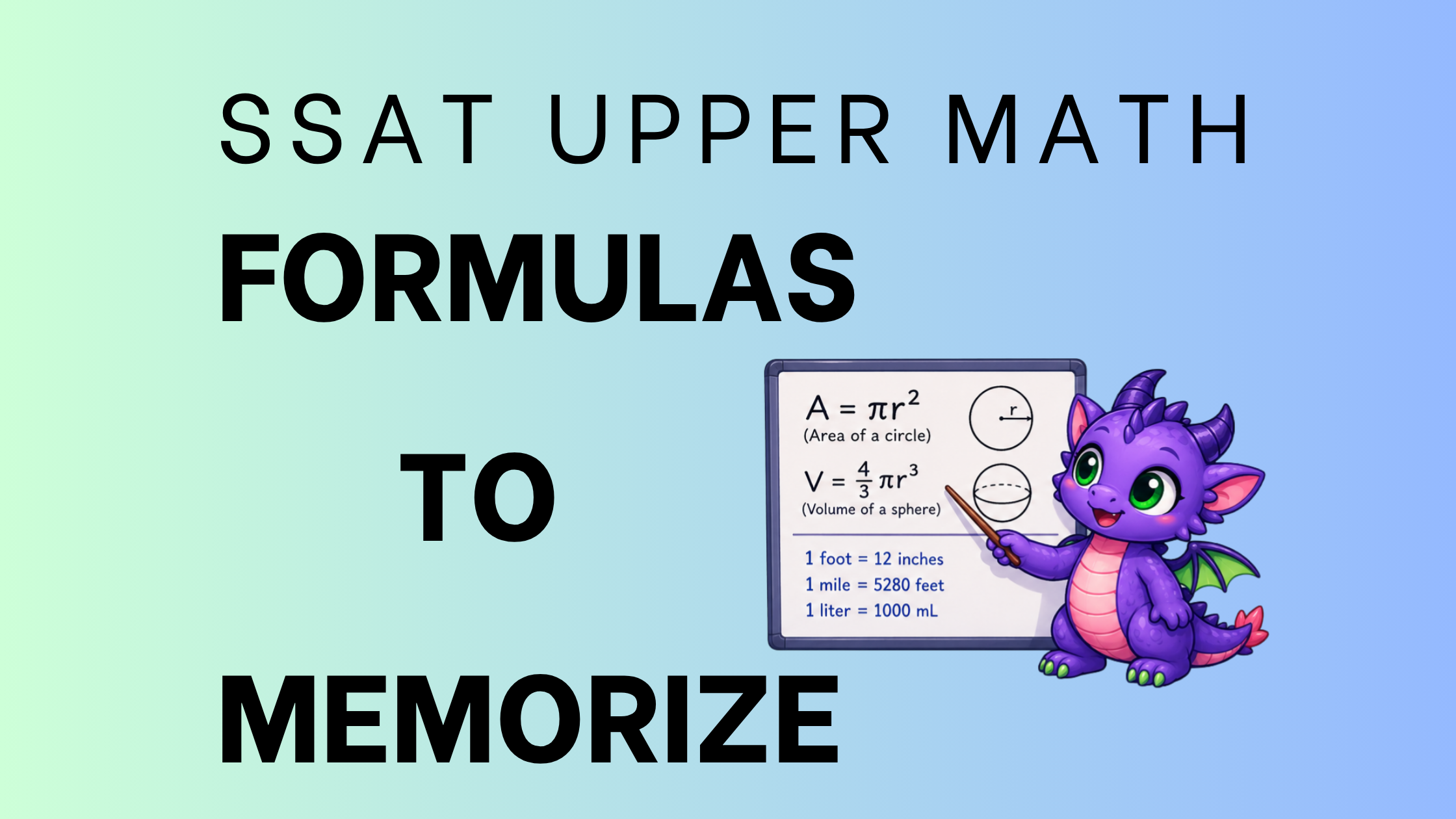
On the SSAT Upper Level math section, students get no formula sheet. Every formula needed to solve a problem has to come from memory — which means memorization isn’t just helpful, it’s the whole game. The list below covers everything your student needs to have locked in before test day, organized by topic.
The short answer: The SSAT Upper Level provides no reference sheet of any kind. Students must memorize formulas for geometry (areas, perimeters, circle, volume), the percent change formula and 10% trick, the average formula and its sum rearrangement, exponent rules, probability, and the Venn diagram overlap formulas. The most time-critical items to memorize are perfect squares through 12², perfect cubes through 6³, and the common fraction-decimal-percent equivalents — students who know these cold work two to three times faster on test day.
A note on scope: this list covers what students are expected to bring to the test themselves. A few formulas — like the volume of a cylinder — are typically provided in the problem when needed. Those aren’t on this list. Everything here is fair game to appear without any hint or definition.
Students must know multiplication and division facts up to 12 × 12 automatically. Not “can figure out” — automatic. Under time pressure with no calculator, slow arithmetic is one of the most common reasons students run out of time. This is the single most valuable thing to practice if it isn’t already solid.
Chapter 13 ofHacking the SSAT Upper Level Math makes the case clearly: students who have the power charts memorized solve exponent problems roughly three times faster than students who don’t.
Order of Operations — GEMDAS
Grouping symbols
Exponents
Multiplication/Division (left to right)
Addition/Subtraction (left to right)
Percents
The 10% Trick
To find 10% of any number, move the decimal one place to the left.
Example: 10% of \$44.20 is \$4.42.
20% = 10% × 2
5% = 10% ÷ 2
15% = 10% + 5%
30% = 10% × 3
This makes most percent calculations on the SSAT doable in seconds without a calculator.
Basic Percent Equation
___ = ___% \(\times\) ___
Example: “12 is what percent of 60?” → \( 12 = p \times 60 \), so \( p = 20\% \)
For a percent increase: New = Old × (100% + change).
For a percent decrease: New = Old × (100% − change).
Common Fraction-Decimal-Percent Equivalents
Memorize these. They appear constantly and knowing them avoids a lot of conversion work:
Fraction
Decimal
Percent
1/10
0.1
10%
1/5
0.2
20%
1/4
0.25
25%
1/3
0.333…
33.3%
1/2
0.5
50%
2/3
0.667…
66.7%
3/4
0.75
75%
1/8
0.125
12.5%
3/8
0.375
37.5%
5/8
0.625
62.5%
7/8
0.875
87.5%
1/20
0.05
5%
The full chart from Chapter 4 of the book has 21 entries and is worth working through with a stopwatch until it’s automatic.
Units, Ratios & Averages
Linear Measurement — What to Memorize
\( 1 \text{ ft} = 12 \text{ in} \)
\( 1 \text{ yd} = 3 \text{ ft} = 36 \text{ in} \)
For other unit categories (weight, volume, time, metric), students should recognize which units belong to which category and understand the metric prefix scale, but don’t need every conversion number memorized — the SSAT provides those values when needed.
Time Conversions
60 seconds = 1 minute
60 minutes = 1 hour
24 hours = 1 day
The Average Formula — Both Directions
\( \text{Average} = \dfrac{\text{Sum of all values}}{\text{Number of values}} \)
Rearranged: \( \text{Sum} = \text{Average} \times \text{Number of values} \)
The rearranged version is what makes the harder average problems on the SSAT solvable — especially the “what score does she need on the next test?” type. Both directions are covered in Chapter 6 of the book.
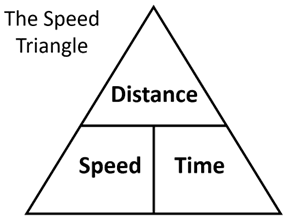
Speed, Distance, Time
\( S = \dfrac{D}{T}, \quad D = S \times T, \quad T = \dfrac{D}{S} \)
Geometry
Geometry makes up roughly 20% of the SSAT math section — more than any other single topic. Every formula below is tested regularly. None are provided.
Triangles
Angles always sum to \( 180° \)
Area: \( A = \dfrac{1}{2}bh \)
Pythagorean Theorem: \( a^2 + b^2 = c^2 \)
Pythagorean Triples — memorize these and their multiples: \( [3, 4, 5] \) and \( [5, 12, 13] \)
45-45-90 triangle sides are in ratio \( 1 : 1 : \sqrt{2} \)
Students who recognize Pythagorean triples on sight almost never need to use the theorem itself. This is one of the biggest time-savers in Chapter 8 of the book. More on this in the Pythagorean triples post.
Rectangles and Squares
Angles sum to \( 360° \)
Perimeter: \( P = 2(l + w) \), or \( P = 4s \) for a square
Area: \( A = lw \), or \( A = s^2 \) for a square
Circles
Circumference: \( C = 2\pi r = \pi d \)
Area: \( A = \pi r^2 \)
One important note: if \( \pi \) appears in the answer choices, don’t multiply by 3.14. Leave the answer in terms of \( \pi \).
Polygons
Sum of interior angles of an n-sided polygon: \( 180(n-2) \)
Each interior angle of a regular polygon: \( \dfrac{180(n-2)}{n} \)
Exterior angles always sum to \( 360° \), regardless of how many sides
Solids
Cube volume: \( V = s^3 \)
Box (rectangular solid) volume: \( V = lwh \)
Exponents
Power Charts
Already listed under Arithmetic — but worth repeating: perfect squares, perfect cubes, and powers of 2 through 10 need to be automatic.
Special Exponents
\( x^0 = 1 \) for any value of \( x \)
\( x^1 = x \)
Negative Exponents
\( a^{-n} = \dfrac{1}{a^n} \)
\( ca^{-n} = \dfrac{c}{a^n} \)
When a whole fraction is raised to a negative exponent, flip the fraction and make the exponent positive:
These three rules, combined with the power charts, cover almost every exponent question on the SSAT Upper Level. Chapter 13 ofHacking the SSAT Upper Level Math walks through each rule with plenty of SSAT-style practice.
Probability and Data
Basic Probability
\( P(\text{event}) = \dfrac{\text{desired outcomes}}{\text{total possible outcomes}} \)
Survey / Venn Diagram Overlap Formulas
These come up in “survey” questions involving two overlapping groups:
Having this list is the first step. Actually memorizing it takes daily repetition — ideally with flashcards or timed self-quizzing on the power charts. Kelly Campbell, author of Hacking the SSAT Upper Level Math, recommends testing the fraction-decimal-percent chart with a stopwatch, aiming for the full chart in under two minutes. Students who hit that threshold have the fluency the test rewards.
If you’d like help building a focused memorization plan alongside targeted practice, book a free 60-minute trial session — it’s a good starting point for figuring out which pieces are already solid and which need the most attention.
All of the formulas and rules above are taught with examples and practice problems across the 18 chapters ofHacking the SSAT Upper Level Math. The Foundations Bundle covers Chapters 1–11 and includes everything in the arithmetic, percent, geometry, averages, and probabilities sections above. The Complete Course adds Chapters 12–18 for students who need the exponent rules and other formulas for advanced algebra (like coordinate geometry) too.
Does the SSAT Upper Level provide a formula sheet?
No. The SSAT Upper Level provides no formula sheet, no reference page, and no scratch paper handout with equations. Every formula a student needs — geometry, algebra, percents, probability — must be memorized before test day. This is one of the most important ways the SSAT differs from school math tests, where formulas are often given.
What geometry formulas do you need for the SSAT Upper Level?
Students need to memorize area and perimeter formulas for triangles, rectangles, and squares; circumference and area for circles; volume for cubes and rectangular solids; the sum of interior angles for polygons; and the Pythagorean theorem. They also need Pythagorean triples ([3, 4, 5] and [5, 12, 13]) and the 45-45-90 triangle ratio (1 : 1 : \(\sqrt{2}\)) memorized for speed.
What math should students have memorized before taking the SSAT?
At a minimum: multiplication and division facts through 12 × 12, perfect squares through 12², perfect cubes through 6³, powers of 2 through 2¹⁰, all geometry formulas listed above, the 10% trick for percents, the percent change formula, the average formula and its sum rearrangement, and the three exponent rules. The common fraction-decimal-percent equivalents are also high-value and often overlooked.
How long does it take to memorize the SSAT math formulas?
Most students can get through the core formulas in two to three weeks of daily review, spending about 10–15 minutes per day on flashcards and timed self-quizzing. The power charts (perfect squares, cubes, powers of 2) take the longest to automate and are worth starting first. Students with a solid school math foundation will find most of the formulas familiar — the goal is automating recall under test-day pressure, not learning new concepts from scratch.



Leave a Reply