How to Approach Any SSAT Math Problem — Even Ones You’ve Never Seen Before
There’s a skill that the SSAT tests that most students never practice in school. It’s not a formula. It’s not a procedure. It’s the ability to look at a problem you’ve never seen before, figure out what type of problem it is, and choose the right approach — all in about five seconds.
That skill is the difference between a student who freezes on test day and a student who works through the section steadily and confidently. And the good news is that it’s completely learnable.
The short answer: To approach any SSAT math problem, start by identifying which of five problem families it belongs to: (1) Calculate Using Arithmetic, (2) Use a Formula, (3) Solve Using Algebra, (4) Read and Interpret Data, or (5) Special Method / Lateral Thinking. Each family tells you which tools to reach for. Spending five to ten seconds on identification before solving is one of the highest-impact habits you can build for the SSAT Upper Level math section.
In school, math is served in neat, labelled portions. You’ve just finished a unit on fractions, so naturally the next ten problems are about fractions. You don’t have to figure out what kind of problem you’re looking at — the context tells you.
The SSAT doesn’t work that way. Each math section has 25 problems covering up to 18 different topics, presented in no particular order and with no labels whatsoever. Every problem is a cold read.
That’s why students who’ve done plenty of regular math homework can still find the SSAT surprisingly disorienting. It’s not that they don’t know the math — it’s that they’ve never had to identify what kind of math they’re doing before doing it. (I go deeper on this distinction in How SSAT Math is Different from School Math.)
The fix is to learn how to approach SSAT math problems systematically, by sorting them into families.
The 5 Problem Families
The SSAT’s question types can be sorted into five broad categories. Once you’ve identified the family, you know which tools to reach for.
Family 1: Calculate Using Arithmetic
This is the largest family by far. Any problem where you’re working with numbers directly — word problems, primes and factors, fractions, decimals and percents, units and ratios, exponents, roots — belongs here.
The clue is that the problem gives you numbers and asks you to do something with them. “A store discounts a $55 table by 40%. What is the sale price?” That’s arithmetic. The path is to pick the right operation (or sequence of operations) and calculate.
Try this one:
Gwi-Joo and Sofie need to buy 44 donuts. A dozen costs \$11, a half-dozen costs \$6, and individual donuts cost \$1.25. What is the least amount they can spend?
This is pure arithmetic — no formula, no algebra. You just need to figure out the right combination and calculate.
These problems ask you to apply a formula you’ve memorized. Geometry questions (area, perimeter, volume, Pythagorean theorem), sequences, averages, and probability questions all fall here.
The clue is that the problem describes a shape, a pattern, a data set, or a probability — something with a known formula attached to it. “What is the probability of randomly picking a green marble from a bag of 5 marbles, if 2 are green?” You don’t need to reason it out from scratch — you need to remember that \( P = \frac{\text{desired outcomes}}{\text{total outcomes}} \) and plug in.
Try this one:
What is the area of a triangle with base 12 and height 8?
The moment you recognise this as a formula problem, you reach for \( A = \frac{1}{2}bh \), plug in, and you’re done in seconds.
These problems have something unknown that you need to find by working algebraically. Equations, inequalities, systems of equations, and many word problems belong here.
The clue is usually some version of “find the value of…” or “what is \( x \)?” — or a word problem where something is missing and you need to build an equation to find it. “If \( 3y + 1 = 10 \), what is \( y \)?” Set up, solve, done.
Try this one: “An art shop sold three types of paint tubes for 55¢, 60¢, and 65¢. The shop made $27, and the same number of each type was sold. How many total tubes were sold?” It looks like a word problem, but the moment you recognise it as algebra, you set up \( 0.55x + 0.60x + 0.65x = 27 \) and solve — much faster than guessing.
The algebra family also includes some of the trickier SSAT formats, like double inequalities and absolute value equations — topics covered in depth in Chapter 12: Algebra — The Hard Stuff of Hacking the SSAT Upper Level Math.
Family 4: Read and Interpret Data
These problems give you a chart, graph, or table and ask you to extract and sometimes calculate with the information shown. Bar charts, line graphs, pie charts, and data tables all appear on the SSAT.
The clue is obvious: there’s a visual. Once you know you’re in this family, your job is to read carefully, pull out the right numbers, and usually do a small arithmetic or percent calculation on top.
Try this one:
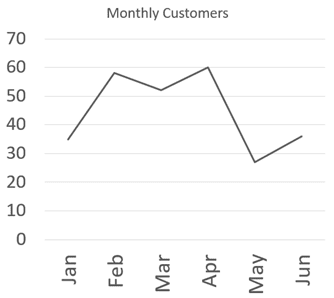
The line graph shows monthly customers. In which month did customers increase the most from the previous month?
Don’t calculate the difference for every month — just look for the steepest upward segment on the chart. Your eyes do the work. Steepest slope equals greatest change, the answer is February. (For more on this, see 5 SSAT Math Shortcuts That Will Save You Serious Time.)
Family 5: Special Method / Lateral Thinking
This is the most distinctive family — and the one students are least prepared for, because these problems look nothing like classroom math.
Symbol problems, letters-as-digits puzzles, “how many groups” questions, and logic problems all belong here. What they have in common is that the problem is asking something slightly different from what it first appears to be asking. They reward careful reading, lateral thinking, and a specific approach for each sub-type — not a formula.
Try this one:
Lily has a collection of pillows. All her pillows are either black, white, or pink. She only collects round and square pillows. If Lily tells you that all her pink pillows are round, which one of the following would prove her wrong?
(A) A black, round pillow
(B) A white, round pillow
(C) A black, square pillow
(D) A white, square pillow
(E) A pink, square pillow
A student who reaches for a formula here is lost. A student who recognises the pattern — find the thing that’s an X but not a Y (in this case, pink but not round) — solves it in seconds.
The clue is that something about the problem feels deliberately unfamiliar or unusual. That feeling is actually useful information: it’s your signal to slow down, re-read, and think about what this specific type of question is really asking. I’ve written a whole post on this: Weird SSAT Questions: How to Handle Symbol Problems and Other Curveballs.
How to Use This on Test Day
When you pick up a problem, spend five to ten seconds asking: which family is this?
That question does two things. First, it tells you which tools to reach for. Second, it tells you how much time to invest. If you can’t quickly identify the family — if something about the problem seems genuinely confusing — that’s your cue to circle it and come back. There’s no penalty for skipping and returning, and spending three minutes stuck on one problem is one of the most common ways students leave points on the table. (See SSAT Math Time Management for more on this.)
How to Build This Skill Through Practice
Identifying problem types is a skill, and like any skill it develops through deliberate practice — not just repetition.
The most effective thing you can do is name the family before you solve. Every time you sit down with a practice problem, look at it, say out loud which family it belongs to, and then solve it. After a few weeks of this, the identification step becomes automatic.
Two other habits that help: keep a running list of problem types as you encounter them, and — crucially — mix up your practice problems instead of drilling 20 problems of the same type in a row. The SSAT mixes them, so your practice should too. Drilling a single topic builds procedural fluency; mixing topics builds recognition, which is what the test actually rewards.
Where the Book Fits In
Hacking the SSAT Upper Level Math is organised by topic across 18 chapters — one for each major concept area. That structure makes it easy to build mastery family by family: work through the arithmetic chapters until those problems feel automatic, then move to geometry, then algebra, and so on. Each chapter also includes mixed SSAT-style practice problems so you’re never just drilling one type.
The Foundations Bundle (Chapters 1–11) covers all the highest-frequency families — arithmetic, formulas, and introductory algebra — for less than the cost of two hours of professional SSAT tutoring. The Complete Course adds the advanced algebra chapters for students aiming at the top percentiles. Both are available at shop.kellymath.com, along with individual chapters.
If you’d like to work with a tutor who explicitly teaches this kind of problem-recognition skill rather than just drilling procedures, I’d love to connect. Book a free 60-minute trial session — no commitment, just a chance to see how we work together.
Frequently Asked Questions: How to Approach SSAT Math Problems
Why does SSAT math feel harder than school math?
The SSAT mixes up to 18 different math topics in 25 questions with no labels and no context clues. In school, you always know what topic you’re working on. On the SSAT, every problem is a cold read — which means identifying the problem type is a skill you have to build deliberately, separate from knowing the math itself.
What is the fastest way to approach an SSAT math problem?
Spend five to ten seconds identifying which of the five problem families it belongs to before doing any math. Once you know the family — arithmetic, formula, algebra, data, or lateral thinking — you know which tools to reach for and how long the problem should take. Students who skip this step often start solving in the wrong direction.
What should you do if you don’t recognise an SSAT math problem?
Circle it and move on. There’s no penalty for skipping a problem and returning to it later, and spending three minutes stuck on one question costs you time on easier problems elsewhere in the section. If you come back and it still feels unfamiliar, check whether it belongs to Family 5 — the special method / lateral thinking family — which often requires slowing down and re-reading rather than reaching for a formula.
How do you build problem-recognition skills for the SSAT?
Name the family out loud before solving every practice problem. After a few weeks of this habit, the identification step becomes automatic. Also mix up your practice problems rather than drilling one topic at a time — the SSAT mixes topics, so your practice should reflect that.
[…] and reading answer choices carefully all in one question. If your student already struggles with multi-step equations, absolute value adds one more layer on […]




Leave a Reply