5 Upper Level SSAT Math Shortcuts They Don’t Teach in School
To save real time on the SSAT Upper Level Math section, learn five test-specific shortcuts: the 10% trick, Pythagorean triples, Choose 1, the steepest line trick, and the survey formula. None of these show up in a school curriculum, because they’re built for a 72-second-per-question test, not classroom understanding. Mastered together, they save 5 to 10 minutes per section — time most students spend rushing the last few questions or leaving them blank.
The short answer: Five SSAT math shortcuts save the most time on test day: the 10% trick for percent problems, Pythagorean triples for right triangles, Choose 1 for polynomial equivalency questions, the steepest line trick for line graphs, and the survey formula for overlapping-group problems. Each replaces a slow, classroom-style method with a pattern the SSAT repeats on nearly every test, and together they can save 5 to 10 minutes per section.
With 25 questions and 30 minutes per section, there’s no time to spare; see SSAT Math Time Management for how that clock actually plays out. These aren’t tricks or gimmicks — they’re legitimate mathematical patterns drawn from the 18 SSAT math topics the test repeats year after year.
Shortcut 1: The 10% Trick (Fractions, Decimals & Percents)
Finding 10% of any number just means moving the decimal one place left — then scale that number up or down to find any other percentage. 20% is 10% doubled, 5% is 10% halved, 15% is 10% plus 5%.
For a \$85 item discounted 30%: 10% of 85 is 8.5, so 30% off is \( 8.5 \times 3 = 25.5 \), and the sale price is \$59.50. The school method (convert 30% to 0.30, multiply, subtract) gets the same answer but takes roughly four times as long. See Chapter 4: Fractions, Decimals & Percents for the rest of the percent shortcuts.
Shortcut 2: Pythagorean Triples (Geometry)
Certain right triangles have whole-number side lengths that repeat throughout the SSAT — memorize them and you never calculate a square root. The two to know are \( [3-4-5] \) (and multiples like \( [6-8-10] \), \( [9-12-15] \)) and \( [5-12-13] \) (and multiples like \( [10-24-26] \)).
Worked Sample Problem:
A right triangle has legs of length 5 and 12. What is the length of the hypotenuse?
(A) 13
(B) 15
(C) 17
(D) 18
(E) 20
Step 1:
Recognize the legs as a known triple: 5 and 12 are the legs of \( [5-12-13] \).
Step 2:
The hypotenuse is the third number in the triple: 13.
The answer is A.
The school method: \( a^2 + b^2 = c^2 \), solved by hand — gets the same answer in roughly 45 seconds. Recognizing the triple takes about 5. Geometry makes up 10 to 12 questions per test, and at least 2 or 3 typically involve right triangles, so this shortcut alone can save a minute or two per section. See Pythagorean Triples on the SSAT and Geometry Shortcuts for more, or Chapter 8: Geometry for the complete chapter.
Shortcut 3: Choose 1 (Quadratics & Polynomials)
When a question asks which expression is equivalent to a polynomial, skip factoring entirely. Plug \( x = 1 \) into the original expression to get a “magic number,” then plug \( x = 1 \) into each answer choice until one matches.
Example:Which of the following is equivalent to \( x^2 – 7x + 12 \)?
Plugging in 1 gives \( 1 \ – \ 7 + 12 = 6 \). Testing the answer choice \( (x-3)(x-4) \) at \( x = 1 \) gives \( (-2)(-3) = 6 \), a match, with no factoring required.
The strategy works on any polynomial equivalency question, including cubics and multi-variable expressions, which matters since most students taking the SSAT haven’t covered factoring at that level yet. See Chapter 17: Quadratics — The Easy Way for the full method, including how it adapts for graph-based questions.
Shortcut 4: Steepest Line Wins (Data Charts)
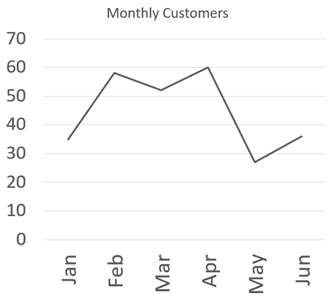
When a line graph question asks for the greatest increase or decrease between two time periods, skip the subtraction. The steepest segment on the graph — sloping up or down — is always the answer. Calculating exact values only matters if two segments look equally steep and you need to confirm.
For this graph, the greatest increase was from January to February, and the greatest decrease was from April to May.
Data chart questions appear on every administration. See Chapter 10: Data Charts for the other four chart types — bar, stacked bar, pie, and table — that use a similar “read it, don’t calculate it” approach.
Shortcut 5: The Survey Formula (Probability)
When a problem describes overlapping groups — students who play both soccer and basketball, say — skip the Venn diagram and use one equation:
Total = Group A + Group B − Both + Neither.
In a class of 30 students where 18 play soccer, 15 play basketball, and 8 play both, that’s \( 30 = 18 + 15 \ – \ 8 + \text{Neither} \), so 5 students play neither sport. Drawing the diagram and filling it in gets the same answer in about a minute; the formula takes 15 seconds. See Venn Diagrams and Survey Problems on the SSAT and Chapter 9: Probability for more survey formulas and how to apply them.
When to Use These Shortcuts (And When Not To)
These shortcuts work best on timed, multiple-choice tests where the pattern is recognizable and you’re confident using it. They’re the wrong tool for homework where a teacher wants full work shown, or for a problem that doesn’t quite fit the pattern — forcing a shortcut onto the wrong problem usually costs more time than it saves. The goal isn’t to replace understanding with tricks; it’s to have both: real understanding for learning, and fast shortcuts for test day.
And if you’d like these shortcuts taught one-on-one, with practice built around exactly where your student needs it, book a free 60-minute trial tutoring session — we’ll start from a real diagnostic and build the plan from there.
Frequently Asked Questions: SSAT Math Shortcuts
What are the best SSAT math shortcuts to learn first?
Start with the 10% trick and Pythagorean triples, since fractions/decimals/percents and geometry together make up nearly half the questions on the test. Once those feel automatic, add Choose 1, the steepest line trick, and the survey formula — all three apply to specific question types that show up on every administration.
Do SSAT math shortcuts work on every problem?
No. Each shortcut applies to a specific pattern — Pythagorean triples only help when the triangle’s sides match a known ratio, and the survey formula only applies to overlapping-group problems. If a problem doesn’t clearly fit the pattern, solving it the standard way is safer than forcing a shortcut that doesn’t apply.
Will using shortcuts hurt my child’s understanding of math?
Not if they’re learned alongside the underlying concepts rather than instead of them. These shortcuts are test-day speed tools, not a replacement for understanding — a student should know why the Pythagorean theorem works even when they’re using the triple shortcut to skip the calculation.
How much time can SSAT math shortcuts actually save?
Used consistently, these five shortcuts save roughly 5 to 10 minutes per 30-minute section — enough to attempt every question, double-check harder problems, and return to anything skipped on the first pass.
[…] that gets you to the answer fastest, not the version that solves it the “long way.” The 5 SSAT Math Shortcuts post covers more examples of this mindset, applied to other question […]
[…] have time, once you have finished solving all the easier questions. You can read more about my top 5 SSAT Shortcuts and best practices for time management on the SSAT in my other […]
[…] bar charts, and pie charts. The steepest-line shortcut is also one of the five shortcuts covered in 5 SSAT Math Shortcuts, if a quick refresher on the other four is useful too. Data chart questions appear on every SSAT […]



Leave a Reply