Pythagorean Triples on the SSAT Upper Level: The #1 Time-Saving Shortcut
Pythagorean triples are the single biggest time-saving shortcut in SSAT Upper Level geometry. Instead of using the Pythagorean theorem to calculate the third side of a right triangle, you recognize the pattern instantly — and move on in seconds. Students who know their triples almost never need to use \( a^2 + b^2 = c^2 \) on test day.
The short answer: A Pythagorean triple is a set of three whole numbers that fits \( a^2 + b^2 = c^2 \). The two you need for the SSAT Upper Level are \( [3, 4, 5] \) and \( [5, 12, 13] \) — plus their multiples.
Any time you see a right triangle and need to find a missing side, check for a triple before reaching for the Pythagorean theorem. You’ll almost always find one. The SSAT tests these in standard right triangle questions, tree and shadow questions, house distance questions, and coordinate plane distance problems.
A Pythagorean triple is a set of three integers that satisfies the Pythagorean theorem: \( a^2 + b^2 = c^2 \).
The most well-known example is \( [3, 4, 5] \), because \( 3^2 + 4^2 = 5^2 \), or \( 9 + 16 = 25 \).
The second triple the SSAT uses regularly is \( [5, 12, 13] \), because \( 5^2 + 12^2 = 13^2 \), or \( 25 + 144 = 169 \).
What makes these useful on a timed test isn’t just knowing the triples themselves — it’s knowing their multiples. Any multiple of a Pythagorean triple is also a valid right triangle.
The SSAT uses multiples constantly — the numbers will be larger, but the relationship is the same.
The Two Triples to Know
Two triples cover nearly every right triangle question on the SSAT Upper Level:
\( [3, 4, 5] \) — the most common. Look for any two sides where the ratio simplifies to 3:4, 3:5, or 4:5. Find the common factor, divide, confirm the triple, then multiply back to find the missing side.
\( [5, 12, 13] \) — appears less often but is still tested. Look for two sides where the ratio simplifies to 5:12, 5:13, or 12:13. Same process: find the multiplier, identify the triple, scale up.
How to Use Pythagorean Triples on the SSAT
The process is the same for every question:
Identify the two known sides of the right triangle.
Find the common factor — what number do you divide by to get to the base triple?
Confirm which triple it is.
Multiply the third number in the triple by the same factor.
Worked Sample Problem:
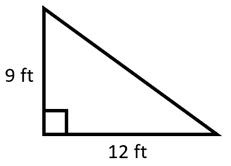
A right triangle has legs of length 9 and 12. What is the length of the hypotenuse?
(A) 13
(B) 15
(C) 17
(D) 18
(E) 21
Step 1: Draw the triangle and look at the two known sides: 9 and 12. These look like multiples of a triple.
Step 2: Divide both by 3. \( 9 \div 3 = 3 \) and \( 12 \div 3 = 4 \). That’s the \( [3, 4, 5] \) triple, with a multiplier of 3.
Step 3: Multiply the hypotenuse by the same factor. \( 5 \times 3 = 15 \).
The answer is (B).
No Pythagorean theorem needed — this takes about five seconds once you recognize the pattern.
Where Pythagorean Triples Show Up on the SSAT
Pythagorean triples are labeled the #1 time-saver in Chapter 8: Geometry of Hacking the SSAT Upper Level Math because they appear across so many different question types. Recognizing them in each setting is part of the skill.
Standard Right Triangle Questions
These give you two sides of a right triangle and ask for the third. They’re the most straightforward application — check for a triple immediately.
Tree and Shadow Questions
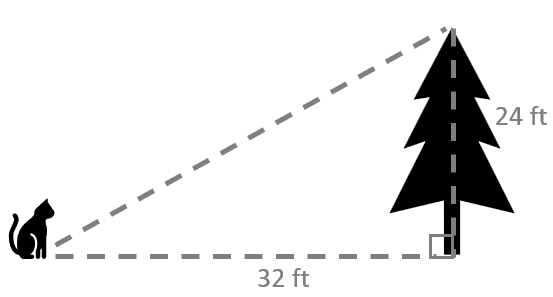
If a question mentions a person looking up at a tall object, a tree casting a shadow, or any similar scenario, it’s describing a right triangle. The height and horizontal distance are the legs; the diagonal distance is the hypotenuse. The SSAT uses triples here too.
Example: Oscar the cat is 32 feet from the base of a 24-foot-tall tree. What is the distance from Oscar to the top of the tree?
\( 24 \div 8 = 3 \) and \( 32 \div 8 = 4 \). That’s a \( [3, 4, 5] \) triple with a multiplier of 8. The distance is \( 5 \times 8 = 40 \) feet.
House and Distance Questions
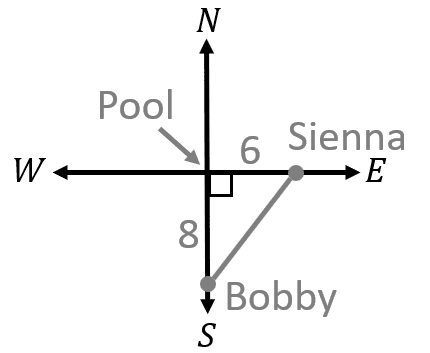
These questions describe two people living some distance from a shared location — a park, a pool, a school — and ask for the distance between the two houses. If directions are given (north, south, east, west), you have a right triangle. If no directions are given, the answer is always “it cannot be determined.”
When directions are given, check for a Pythagorean triple right away.
Example: Bobby lives 8 kilometres south of the community pool, and Sienna lives 6 kilometres east of the same pool. How far is Bobby’s house from Sienna’s house?
\( 6 \div 2 = 3 \) and \( 8 \div 2 = 4 \). That’s a \( [3, 4, 5] \) triple with a multiplier of 2. The distance is \( 5 \times 2 = 10 \) km.
Coordinate Plane Distance Problems
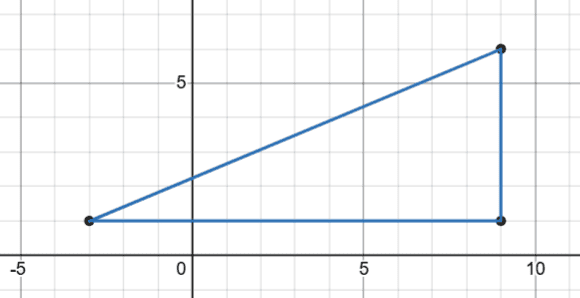
Finding the distance between two points on a coordinate plane is a Pythagorean triple problem in disguise. Draw a right triangle using the two points as endpoints of the hypotenuse. Calculate the horizontal and vertical legs by subtracting coordinates. Then check for a triple. This comes up in Chapter 15: Linear Equations & Graphing as well as Chapter 8, because the coordinate plane adds one more place the SSAT can hide a right triangle.
Example: Find the distance between \( (-3, 1) \) and \( (9, 6) \).
Horizontal distance: \( 9 – (-3) = 12 \). Vertical distance: \( 6 – 1 = 5 \). The legs are 5 and 12 — that’s the \( [5, 12, 13] \) triple. The distance is 13.
Common Mistakes to Avoid
Using the Pythagorean theorem when you don’t need to. Students who don’t know their triples spend two or three minutes calculating what a triple-spotter solves in seconds. The SSAT is designed this way on purpose.
Forgetting to check for a multiplier. The numbers won’t always be 3, 4, and 5 — they’ll be 9, 12, and 15, or 6, 8, and 10. Always ask: what do I divide by to get to the base triple?
Assuming every right triangle is a triple. It’s not — and when it isn’t, the Pythagorean theorem is your backup. But on the SSAT Upper Level, the test-makers strongly prefer triples, so check first.
Mixing up the legs and the hypotenuse. The hypotenuse is always the largest number and always opposite the right angle. In \( [3, 4, 5] \), the 5 is the hypotenuse. In \( [5, 12, 13] \), the 13 is the hypotenuse.
Where Pythagorean Triples Fit in Your SSAT Prep
Geometry is the most-tested topic on the SSAT Upper Level — up to 12 of the 50 math questions come from geometry. Pythagorean triples are one of the most reliable ways to pick up points in that section because they appear so consistently and reward pattern recognition over calculation. Kelly Campbell covers all the right triangle question types in Chapter 8: Geometry, including standard questions, tree problems, house problems, and coordinate plane problems — with full worked examples for each type.
Chapter 8 is part of the Foundations Bundle, which covers all 11 foundational chapters for less than the cost of two hours of professional SSAT tutoring.
The Complete Course adds all 7 advanced chapters for students aiming at the top percentiles — also less than two hours of tutoring from a big name company.
If you’d like to work through geometry shortcuts and the other high-frequency SSAT topics with a tutor, book a free 60-minute trial session. We’ll identify exactly where your student’s geometry gaps are and build from there.
Frequently Asked Questions: Pythagorean Triples on the SSAT Upper Level
Do you need to know the Pythagorean theorem for the SSAT Upper Level?
You should know it as a backup, but students who recognize Pythagorean triples almost never need to use it on test day. The SSAT strongly favors right triangles with whole-number sides — which means triples and their multiples appear constantly. Knowing \( [3, 4, 5] \) and \( [5, 12, 13] \) cold is more valuable than being fast at the theorem.
What Pythagorean triples appear on the SSAT Upper Level?
The two essential triples are \( [3, 4, 5] \) and \( [5, 12, 13] \). The multiples are just as important as the base triples — the SSAT regularly uses numbers like 6, 8, 10 or 9, 12, 15 rather than the base triple itself.
How do you spot a Pythagorean triple on the SSAT?
Any time a question involves a right triangle and asks for a missing side, check the two given sides for a common factor. Divide both by that factor and see whether the result matches 2 of the sides of a [ 3 – 4 – 5 ] or a [ 5 – 12 – 13 ] triangle. If it does, you have a triple — multiply the missing side of the base triple by the same factor.
Where else do Pythagorean triples appear besides basic right triangle questions?
Pythagorean triples show up in tree and shadow questions, house distance questions, and coordinate plane distance problems. In all three cases, the key is recognizing that a right triangle is hiding in the problem – even when the question doesn’t use the word “triangle.” Once you see the right triangle, the rest is the same shortcut.


Leave a Reply