How Do You Find the GCF and LCM on the SSAT Upper Level?
To find GCF and LCM on the SSAT Upper Level, use mental-math shortcuts first — most questions don’t require a full factor tree — and always check the answer choices before calculating. GCF and LCM on the SSAT Upper Level appear not just as direct questions but also disguised as geometry and probability problems. Students who recognize the patterns solve them in under a minute; students who don’t can spend three minutes drawing diagrams and still get the wrong answer.
What Are GCF and LCM, and Why Does the SSAT Test Them?
GCF (Greatest Common Factor) is the largest number that divides evenly into two or more numbers. LCM (Least Common Multiple) is the smallest number that is a multiple of two or more numbers. They’re not just abstract concepts — the SSAT tests them because they show up constantly in real problems:
LCM is used to find common denominators when adding or subtracting fractions
Both appear as direct questions, and both hide inside geometry and probability problems
If your student is shaky on factors and multiples in general, it’s worth starting with Chapter 4: Primes, Factors & Multiples, which covers the whole landscape — divisibility rules, prime factorization, GCF, and LCM — before diving into these specific question types.
Which is Which? Memory Trick
REMEMBER:
GCF has to be smaller than or equal to the smallest number in the group.
LCM has to be larger than or equal to the largest number in the group.
GREATEST common factor → SMALL
LEAST common multiple → LARGE
It seems a little backwards, but that’s exactly how to remember which is which!
GCF Shortcuts That Save Time on the SSAT
Before reaching for pencil and paper, students should know these mental-math shortcuts:
If all numbers are prime, the GCF is 1. The GCF of 2, 5, and 13 is just 1 — no calculation needed.
The GCF of two numbers can’t be larger than their difference. So the GCF of 30 and 35 can be at most 5. That alone eliminates most answer choices.
If one number is a multiple of the other, the GCF is the smaller number. The GCF of 25 and 50 is 25.
These three shortcuts handle a good proportion of SSAT GCF questions without a factor tree in sight.
LCM Shortcuts That Save Time on the SSAT
The LCM has its own set of shortcuts worth knowing cold:
If all the numbers are prime, their LCM is their product. The LCM of 2, 3, and 7 is simply \( 2 \times 3 \times 7 = 42 \).
If two numbers share no common factors, multiply them. The LCM of 8 and 9 is \( 8 \times 9 = 72 \).
The LCM must be at least as large as the biggest number in the set. This is a game-changer on multiple-choice questions — students can often eliminate two or three answer choices immediately.
If one number is a multiple of the other, the LCM is the larger number. The LCM of 20 and 80 is 80.
Take this actual SSAT-style question from Chapter 4:
What is the LCM of 72 and 96?
(A) 12 (B) 24 (C) 72 (D) 96 (E) 288
Using the “LCM must be at least as large as the bigger number” shortcut, choices A, B, and C are gone immediately — they’re all smaller than 96. Then check whether 96 is divisible by 72. It isn’t, so D is out too. The answer is E, and it took about ten seconds.
When Factor Trees Are the Right Move
When the shortcuts don’t get you all the way there, factor trees are the reliable fallback. Here’s the method from Chapter 4:
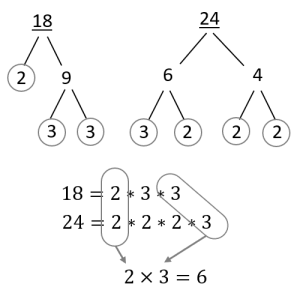
To find the GCF using factor trees:
Make a factor tree for each number
Write the prime factorization of each in expanded form (no exponents)
Circle the prime factors that appear in both factorizations
Multiply the circled factors together
For example, to find the GCF of 18 and 24:
To find the LCM using factor trees:
Make a factor tree for each number
Write the prime factorization of each
For each prime factor, keep only the one with the highest exponent
Multiply those together
To find the LCM of 18 and 24:
The key difference: GCF uses the common factors; LCM uses the highest power of each factor.
The Geometry Disguise: SSAT Multiples Problems
This is the part that surprises most students — and it’s one of the most interesting question types in the book.
Worked Sample Problem:
If \( z \) is a positive integer, which of the following could be the length of segment AB?
(A) 16 (B) 21 (C) 42 (D) 51 (E) 63
At first glance, this looks like a geometry question. It’s not. Here’s how to solve it:
Step 1: Add the three segment expressions. \( AB = 2z + 4z + 11z = 17z \)
Step 2: Since \( z \) is a positive integer, \( AB \) must be a multiple of 17.
Step 3: List multiples of 17: 17, 34, 51, 68…
Only answer choice D, 51, appears on that list. \( 17 \times 3 = 51 \), so \( z = 3 \). The answer is D.
Confusing GCF and LCM. On the SSAT, this mix-up is built into the wrong answer choices. Students who remember GCF = smaller result, LCM = larger result can often use that alone to eliminate one or two options.
Forgetting to use answer choices first. The LCM elimination trick (rule out anything smaller than the largest number) is free points. Always check the choices before doing any calculation.
Using only factor trees for every problem. Factor trees are reliable, but they’re slow. The mental-math shortcuts above handle the majority of SSAT GCF and LCM questions faster.
Where This Fits in SSAT Prep
GCF and LCM problems appear throughout the SSAT — not just in their own chapter. They’re the engine behind fraction simplification, common denominators, and those disguised geometry problems above. Getting comfortable with them early pays dividends across multiple question types.
Chapter 4 of Hacking the SSAT Upper Level Math covers all of this: number sets, primes, divisibility rules, factors, multiples, GCF, and LCM — with SSAT-style practice questions throughout. You can grab Chapter 4 individually or browse the full book and bundle options to find the right fit for where your student is right now.
And if you’d like personalized help identifying which gaps are holding your student back — and working through them with strategies tailored to the actual test — book a free 60-minute trial tutoring session. No commitment, just a chance to see how the right approach can change things.
Frequently Asked Questions: GCF and LCM on the SSAT Upper Level
What is the difference between GCF and LCM on the SSAT Upper Level?
GCF (Greatest Common Factor) is the largest number that divides evenly into two or more numbers; LCM (Least Common Multiple) is the smallest number that is a multiple of all numbers in a set. On the SSAT Upper Level, GCF questions are often used to simplify fractions, while LCM questions come up with common denominators and in disguised geometry problems. A quick rule of thumb: GCF produces a smaller result, LCM produces a larger one.
Do SSAT Upper Level students need to use factor trees for every GCF and LCM problem?
No. Most GCF and LCM questions on the SSAT Upper Level can be solved faster with mental-math shortcuts than with factor trees. The most important LCM shortcut is that the LCM must be at least as large as the biggest number in the set — this alone eliminates most wrong answer choices before any calculation is needed. Factor trees are the reliable fallback when shortcuts don’t apply.
How does GCF show up in SSAT geometry problems?
Some SSAT geometry problems give a figure with segment lengths or angle measures written as multiples of a variable (like \( 2z \), \( 4z \), and \( 11z \)) and ask which answer choice could be the total length or measure. The key is to add the expressions, find the coefficient (like 17 in \( 17z \)), and then identify which answer choice is a multiple of that number. These problems look like geometry but are really testing knowledge of multiples.
How many GCF and LCM questions appear on the SSAT Upper Level?
There is no fixed number, but GCF and LCM concepts appear both as direct questions and embedded in other question types — fractions, geometry, and probability. Students who are solid on GCF and LCM tend to pick up points in multiple sections of the test, not just the questions that explicitly name these concepts.







Leave a Reply