The ‘Weird’ SSAT Question Types: Symbols, Letters, and Puzzles
SSAT symbol problems look confusing by design — but they’re not actually hard once you know the patterns. The same is true for letters-for-digits and logic problems. These question types show up on every SSAT and reward students who’ve seen them before, because the solving system is always the same.
The short answer: The three “weird” SSAT question types are symbol problems (invented operations), letters-for-digits (cryptarithmetic), and logic problems (find the counterexample). Symbol problems are solved by substituting values into the given definition. Letters-for-digits problems are solved by working column by column, using carries and even/odd reasoning. Logic problems are solved by identifying what would disprove the “all” statement. None of these require memorized formulas — just a systematic approach.
These questions appear in Chapter 11 of Hacking the SSAT Upper Level Math by Kelly Campbell, which covers all three types with 36 practice problems. This post walks through the system for each one.
These questions test something different from regular math. A standard SSAT question asks: do you know the Pythagorean theorem? Can you solve for \( x \)? SSAT symbol problems and puzzles ask something else entirely: can you follow unfamiliar rules? Can you recognize patterns under pressure?
That distinction matters. Secondary school math constantly introduces new concepts. Students who can adapt to unfamiliar problems succeed. Students who freeze when they see something new struggle. These question types are the SSAT’s way of testing that adaptability — which is exactly why they’re worth practicing specifically.
Question Type 1: SSAT Symbol Problems (Invented Operations)
What they look like
Let \( a \heartsuit b = 2a + 3b \). What is \( 4 \heartsuit 5 \)?
Why they’re confusing
Students see a symbol they don’t recognize and panic. The fix is simple: it’s just substitution.
The system for symbol problems
Step 1: Read the definition carefully. \( a \heartsuit b = 2a + 3b \) means: multiply the first number by 2, multiply the second by 3, then add.
Step 2: Substitute the given values.
\( 4 \heartsuit 5 = 2(4) + 3(5) = 8 + 15 = 23 \)
That’s it. This type of SSAT symbol problems are just substitution problems.
Worked example: symbol operations
Let \( x \star y = x^2 – 2y \). What is \( 3 \star 4 \)?
\( 3 \star 4 = 3^2 – 2(4) = 9 – 8 = 1 \)
Answer: 1
Advanced symbol problems: solve for the unknown
Some symbol problems ask you to rearrange rather than just substitute. For example:
\( 32 \times \blacktriangle = \blacklozenge + \blacklozenge + \blacklozenge + \blacklozenge \). What is \( \dfrac{\blacklozenge}{\blacktriangle} \)?
Let \( d = \blacklozenge \) and \( t = \blacktriangle \). Then:
\( 32t = 4d \)
Divide both sides by \( t \):
\( 32 = \dfrac{4d}{t} \)
Divide both sides by 4:
\( 8 = \dfrac{d}{t} \)
Answer: 8
The key strategy: read the definition, substitute, follow order of operations. Never panic about the symbol itself — it’s just a placeholder for a rule.
Question Type 2: Letters-for-Digits (Cryptarithmetic)
These problems look like algebra but aren’t. Each letter represents a different digit from 0–9. The goal is to figure out which digit each letter represents.
The system for letters-for-digits problems
There are five steps. Work through them in order every time.
Step 1: Start with the leftmost column. This column tells you the most — specifically whether there’s been a carry, and what the leading digit must be.
Step 2: Use the double-letter columns. When the same letter appears twice in a column (like \( S + S \)), it can only take two possible values — one with no carry and one with a carry.
For example, \( S + S = 6 \) means \( S = 3 \); \( S + S = 16 \) means \( S = 8 \).
Step 3: Use even and odd reasoning. An odd digit in a doubled-letter column means a 1 was carried from the column to the right. An even digit means no carry happened. This lets you choose between the two possible values for each letter.
Step 4: Try values and work through the columns.
Step 5: Check your answer by plugging back in.
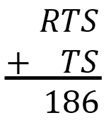
Worked example: RST + RST = 186 (letters-for-digits)
Step 1: Leftmost column.
The hundreds column tells us \( R = 1 \), and there is no carry from the tens column.
Step 2: Double-letter columns.
Ones column: \( 2S = 6 \) or \( 16 \), so \( S = 3 \) or \( 8 \).
Tens column: \( 2T = 8 \) or \( 18 \), so \( T = 4 \) or \( 9 \).
Step 3: Even and odd reasoning.
The tens digit of the answer is even. That means no carry came from the ones column — so \( S = 3 \), not 8.
Step 4: Try values.
If \( S = 3 \), no carry goes to the tens column. The tens digit is 8, and there is no carry to the hundreds column — so \( T = 4 \), not 9.
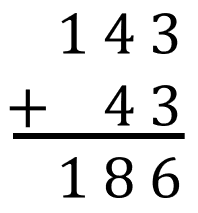
We now have: \( R = 1 \), \( T = 4 \), \( S = 3 \).
Step 5: Check.
Worked example: LMN + MN = 178
Step 1: The hundreds column gives us \( L = 1 \), with no carry from the tens column.
Step 2: Ones column: \( N + N = 8 \) or \( 18 \), so \( N = 4 \) or \( 9 \).
Step 3: The tens digit is 7, which is odd. An odd digit means a carry came from the ones column — so \( N = 9 \).
Now: \( M + M + 1 = 7 \) in the tens column, with no carry to the hundreds. So \( M = 3 \).
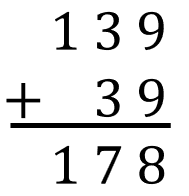
Step 5: Check.
\( L = 1 \), \( M = 3 \), \( N = 9 \). ✓
The key strategy: leftmost column first, double-letter columns next, use even/odd to choose between values, check your work, then answer the actual question.
Lily has a collection of pillows. All her pillows are either black, white, or pink. She only collects round and square pillows. If Lily tells you that all her pink pillows are round, which one of the following would prove her wrong?
(A) A black, round pillow
(B) A white, round pillow
(C) A black, square pillow
(D) A white, square pillow
(E) A pink, square pillow
The system for logic problems
Step 1: Identify the “all” statement. Here: “All her pink pillows are round.”
Step 2: Identify what would disprove it. If Lily had a pink pillow that was NOT round — i.e., a pink square pillow — that would prove her wrong.
Step 3: Find it in the answer choices. Answer E.
These problems look harder than they are. The answer is always the one item that directly contradicts the “all” statement.
How to Practice These Question Types
These question types are rare in school but predictable on the SSAT. The goal in practice is pattern recognition — seeing the type, knowing the system, and executing quickly.
For symbol problems, start with 5–10 basic substitution problems, then move to the “solve for the unknown” type. For letters-for-digits, work through problems slowly at first — the five-step system takes repetition to become automatic. For logic problems, a handful of examples is usually enough; the pattern is simple once you’ve seen it twice.
All three types are covered in more depth in Chapter 11 of the book, alongside the question types that appear most frequently on the SSAT. If you’d like to work through these with guidance, book a free 60-minute trial session — one session is usually enough to make all three types feel manageable.
Frequently Asked Questions: SSAT Symbol Problems and Puzzles
What are SSAT symbol problems?
SSAT symbol problems use invented operations — a made-up symbol like a heart or star — and define a rule for how it works. Students are then asked to apply that rule to specific numbers. They’re solved by substituting the given values into the definition and following order of operations. No prior knowledge of the symbol is needed; the definition is always provided in the problem.
How do you solve letters-for-digits problems on the SSAT?
Letters-for-digits problems are solved using a five-step system: start with the leftmost column to identify leading digits and carries, use double-letter columns to find two possible values for each letter, apply even/odd reasoning to choose between those values, test your values column by column, and check by plugging back in. The key insight is that a carry from the previous column makes a digit odd; no carry leaves it even.
Are symbol problems hard on the SSAT upper level?
Symbol problems are among the most learnable question types on the SSAT. Students who panic on them have usually never seen them before — students who’ve practiced the substitution system find them quick and reliable. Letters-for-digits problems take more practice to become automatic, but follow the same predictable structure every time.
How do I find the counterexample in an SSAT logic problem?
SSAT logic problems give you an “all” statement and ask which answer choice would prove it wrong. The answer is always the item that satisfies the subject of the statement but violates its condition — for example, if the statement is “all pink pillows are round,” the counterexample is a pink pillow that is not round. Ignore the other answer choices; they can’t disprove an “all” statement.








Leave a Reply