SSAT Upper Level Math Word Problems: How to Approach Them
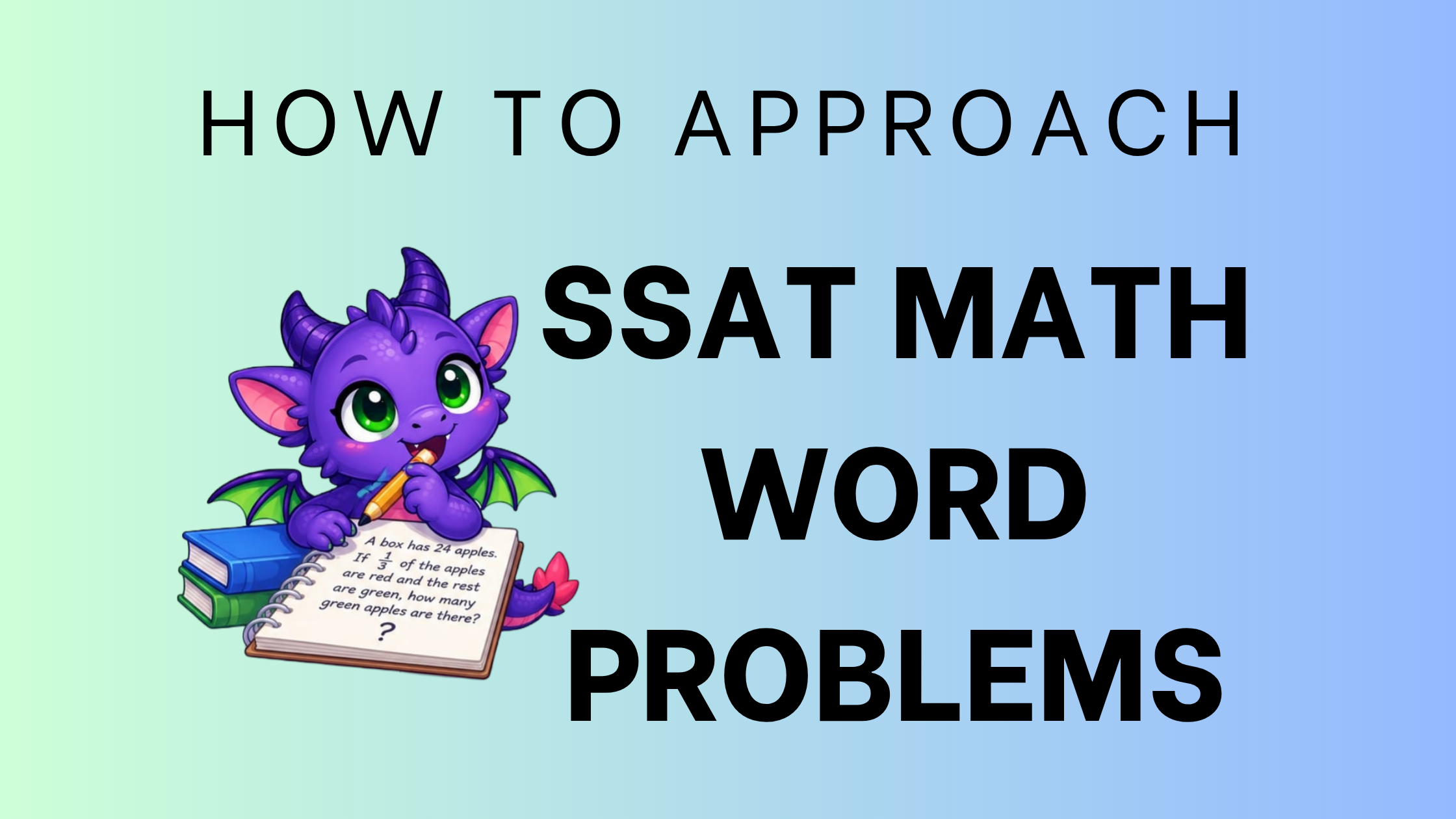
The single most effective way to handle SSAT upper level math word problems is to recognize which type of problem you’re looking at before you start solving. SSAT word problems fall into a small number of recurring patterns — and each pattern has a specific approach that makes it fast and manageable. Students who learn to identify the type first stop feeling intimidated by long problems and start seeing them as familiar puzzles.
The short answer: Most SSAT upper level math word problems belong to one of three categories: long problems that are actually simple arithmetic once you strip them down, survey problems that solve in one line with the survey formula, and multi-person logic problems that use systems of equations. Recognizing the type is the first step — after that, the math is usually straightforward.
A long word problem with five sentences and a lot of names and numbers looks overwhelming — but length is not the same as difficulty. The longest SSAT word problems are often the easiest mathematically. They just require more careful reading.
The real challenge with SSAT upper level math word problems isn’t the math — it’s staying organized, identifying what’s being asked, and not getting distracted by information that doesn’t matter. That’s a learnable skill, and it’s exactly what Chapter 2: Word Problems of Hacking the SSAT Upper Level Math is built around.
The markup method — boxing the actual question, circling numbers, crossing out irrelevant details — is the foundation. But knowing the three main word problem types takes it further, because once you recognize the pattern, you already know the approach before you’ve read to the end.
Type 1: Long Problems That Are Actually Simple Arithmetic
These are the word problems that look the most intimidating and are often the most straightforward. They’re long because the SSAT is testing whether you can read carefully and stay organized — not whether you can do complex math.
A typical example: a problem about a student selling items, with a discount partway through, asking for a total or a minimum number. Five sentences. Lots of dollar amounts. But the math is just multiplication, subtraction, and division.
The approach — the mark-up method:
Box the actual question being asked before you start solving
Circle all the numbers
Cross out any details that don’t affect the calculation
Translate what’s left into simple math steps, one at a time
The most common mistake on this type is answering the wrong question — solving for the total raised instead of the number of items still needed, for example. Boxing the question first prevents this.
When a problem looks long and scary, the first thing to do is mark it up. Most of the time, once you’ve crossed out the fluff, you’re left with two or three arithmetic steps.
Type 2: Survey Problems — One Formula, Done in Seconds
Survey problems are one of the SSAT’s favorite word problem formats, and they’re instantly recognizable: the problem will mention a survey, a group of people, and two overlapping categories. They look complicated because of all the numbers — but they solve in a single step once you know the formula.
The survey formula:
“How many in both?” → \( \text{Both} = A + B – \text{Total} \)
“How many in neither?” → \( \text{Neither} = \text{Total} – (A + B – \text{Both}) \)
That’s it. Identify which version the question is asking, plug in the numbers, and you’re done.
Worked Sample Problem:
In a survey of 200 students, each student reported liking math, science, or both. If 140 students like math and 95 students like science, how many students like both math and science?
(A) 25 (B) 30 (C) 35 (D) 40 (E) 45
Step 1: Identify the question type. The word “survey” and the phrase “both” tell us to use the intersection formula.
Step 2: Apply the survey formula. \( \text{Both} = A + B – \text{Total} \) \( \text{Both} = 140 + 95 – 200 \) \( \text{Both} = 35 \)
The answer is (C).
The whole thing takes about 15 seconds. Without the formula, a student might spend two minutes drawing a Venn diagram and still get it wrong.
Spot this type by looking for the word “survey” near the beginning of the problem, and either “both” or “neither” near the end. The full breakdown of survey problems — including the “neither” version and combined events — is covered in Chapter 17: Probability.
Type 3: Multi-Person Logic Problems
These problems introduce several people with relationships between their ages, scores, amounts, or quantities. They look like a logic puzzle but are actually a system of equations in disguise.
A typical version: “Anna has three times as many stickers as Ben. Carlos has five fewer than Anna. Together they have 55. How many does Ben have?”
The approach:
Assign a variable to the person with the least information (usually the one everyone else is described in relation to)
Translate each sentence into an equation
Solve the system
The key insight is to identify who to make the variable. Students who try to assign variables to everyone get stuck with too many unknowns. Picking the right starting person — the one all others are described in relation to — collapses the whole problem into one equation with one variable.
This connects directly to the systems of equations strategies in Chapter 12: Systems of Equations, where the substitution method makes multi-person problems fast and reliable.
The Most Important Habit: Identify Before You Solve
With SSAT upper level math word problems, the first 10 seconds should be spent identifying the problem type — not starting the math. Ask: Is this a survey problem? Is this a multi-person logic problem? Or is this a long problem that’s actually simple arithmetic?
Once you know the type, you know the approach. And knowing the approach before you start is the difference between a student who panics at a long problem and a student who circles it confidently and knocks it out in 30 seconds.
For structured practice with all three types — including the markup method, the survey formula, and systems of equations word problems — see Chapter 1: SSAT Strategy & Word Problems from Hacking the SSAT Upper Level Math. And if you’d like to work through these problem types one-on-one, book a free 60-minute trial session — word problems are one of the most common areas where a single session makes a significant difference.
Frequently Asked Questions: SSAT Upper Level Math Word Problems
Why are SSAT math word problems so much harder than school word problems?
SSAT word problems are harder to navigate than school problems mainly because of time pressure and unfamiliar question types — not because the underlying math is more advanced. School word problems tell you which topic you’re practicing. SSAT problems don’t. Learning to recognize the type of problem from the structure of the question — rather than the math content — is the skill that makes SSAT word problems manageable.
What is the survey formula for the SSAT?
The SSAT survey formula solves problems about two overlapping groups: to find how many people are in both groups, use Both = A + B − Total. To find how many are in neither group, use Neither = Total − (A + B − Both). Survey problems are identifiable by the word “survey” near the start and “both” or “neither” near the end. Once you recognize the type, the problem solves in a single step.
How do I know which variable to use in a multi-person SSAT word problem?
Assign the variable to the person that everyone else is described in relation to — usually the one mentioned last or the one with the fewest direct clues. If Anna has three times as many as Ben, make Ben the variable. Every other person’s amount becomes an expression in terms of that variable, which collapses the problem into a single equation.
Should I draw diagrams for SSAT math word problems?
For geometry word problems, yes — always draw a diagram and mark it with all the information given. For non-geometry word problems, a diagram is usually not necessary and can waste time. The mark-up method (boxing the question, circling numbers, crossing out irrelevant details) is faster and more reliable for most SSAT word problem types.


Leave a Reply