How Do You Solve Basic Angle Problems on the SSAT Upper Level?
To solve basic angle problems on the SSAT Upper Level, you rely on four relationships: complementary angles sum to 90°, supplementary angles sum to 180°, vertical angles are always equal, and a bisector splits an angle into two equal halves. Almost every basic angle question is really just one of these four rules in disguise, applied to whatever numbers and figure the question gives you.
The short answer: Complementary angles add to 90°, supplementary angles add to 180°, and angles on a straight line are always supplementary. Vertical angles — the angles directly across from each other where two lines cross — are always congruent. An angle bisector splits an angle into two equal parts. Once you know which relationship applies, most basic angle problems take one subtraction or division step to solve.
What Are Basic Angle Problems, and Why Does the SSAT Test Them?
In Kelly Campbell’s tutoring experience, angle problems test whether a student recognizes a relationship quickly, not whether they can do complicated math. The numbers involved are usually simple. The challenge is spotting which rule applies to the figure in front of you. For a full rundown of angle vocabulary — acute, right, obtuse, straight, reflex, vertex, perpendicular, and more — see the SSAT geometry terms glossary. This post focuses on the relationships themselves, since that’s where most of the actual problem-solving happens.
Basic angle problems also build directly toward harder geometry content. Triangle angle problems, polygon angle problems, and parallel-line problems all lean on the same core rules covered here. Getting these fundamentals automatic pays off across the rest of Chapter 8 – Geometry: The Complete Picture in Kelly Campbell’s book Hacking the SSAT Upper Level Math.
The Angle Relationship Rules to Know Cold
Complementary Angles
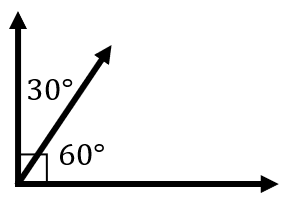
Complementary angles add up to 90°. If a right angle is split into two smaller angles, those two angles are complementary. Each one can be found by subtracting the other from 90°.
If a right angle is split by a ray into two parts, and one part measures 30°, the other part measures \( 90 – 30 = 60° \).
Supplementary Angles
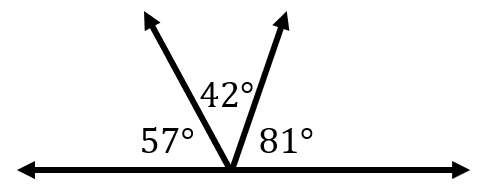
Supplementary angles add up to 180°. Any two angles that sit on a straight line together are automatically supplementary, since a straight line always measures 180°.
If three angles sit together on a straight line and two of them measure 57° and 42°, the third angle measures \( 180 – 57 – 42 = 81° \).
Vertical Angles
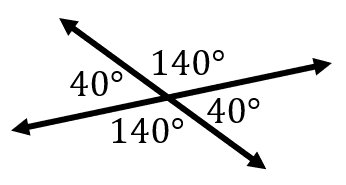
When two lines cross, they form two pairs of vertical angles — the angles directly across from each other at the intersection. Vertical angles are always equal, no calculation required. The other pairs of angles at that same intersection, the ones next to each other rather than across, are always supplementary.
At any intersection of two lines, this means only one angle measure needs to be given. Once you know one angle, the vertical angle matches it exactly, and both remaining angles can be found by subtracting from 180°.
Angle Bisectors
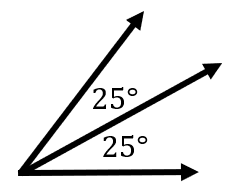
A bisector is a ray or line that splits an angle into two exactly equal parts. If a bisector splits a 50° angle, each resulting half measures 25°. Bisector problems almost always work in one of two directions. Either the full angle is given and the question asks for a half, or a half is given and the question asks for the full angle. The second version just means doubling instead of dividing.
Worked Sample Problem
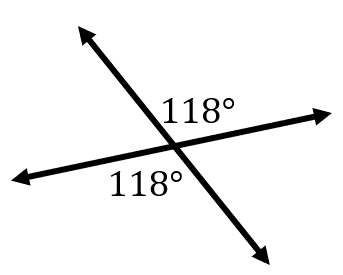
Two lines intersect, forming four angles. One of the four angles measures 118°. What are the measures of the other three angles?
Step 1: Sketch it out, label an obtuse angle 118°.
The angle directly across from the 118° angle is a vertical angle, so it also measures 118°.
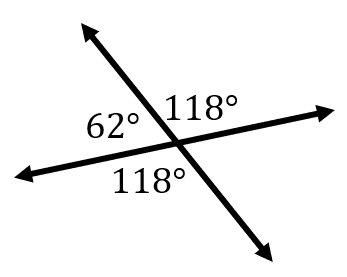
Step 2: Find one of the adjacent angles using the supplementary angle rule.
Any angle next to the 118° angle is supplementary to it.
\( 180 – 118 = 62° \)
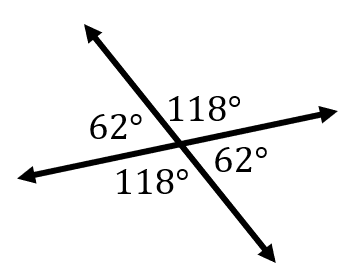
Step 3: Find the last angle.
The final angle is vertical to the 62° angle just found, so it also measures 62°.
Result: The four angles measure 118°, 118°, 62°, and 62°.
A single given angle at an intersection is always enough to find all four angles. That’s the pattern worth remembering: one number in, three answers out.
Common Mistakes to Avoid
A handful of errors show up again and again in basic angle problems.
Assuming all four angles at an intersection are equal. Only the angle directly across — the vertical angle — matches the given angle. The two adjacent angles are a different measure entirely, found through subtraction from 180°, not by copying the given number.
Mixing up complementary and supplementary. Complementary angles add to 90°, supplementary angles add to 180°. A quick way to keep them straight: “c” comes before “s” in the alphabet, and 90 comes before 180.
Forgetting that bisector questions can go in either direction. If a question gives the smaller half and asks for the full angle, the answer requires multiplying by 2, not dividing. Reading the question carefully for which piece is given avoids this mix-up.
Trying to measure the figure instead of using the given numbers. SSAT diagrams are frequently not drawn to scale. An angle that looks obtuse in the picture might actually be acute according to the numbers given. Trust the math, not the drawing.
Where Does This Fit in Your SSAT Prep?
These four relationships are the foundation for the angle section of Chapter 8 of Hacking the SSAT Upper Level Math. That chapter builds into triangle angles, polygon angle formulas, and parallel lines with transversals. Students who have complementary, supplementary, vertical, and bisector relationships automatic move through the rest of the geometry chapter much faster, since those later topics all lean on the same core logic.
For full SSAT Upper Level Math prep, the Complete Course walks through all 18 chapters – 545 pages covering nothing but SSAT Upper Level Math, written the way a tutor actually explains it, built from real experience working with 50+ SSAT students. If you’d like personalized help along with it, explore the book + tutoring packages.
If you’re not sure where to start, Kelly offers a free SSAT Upper Level Math diagnostic on her homepage. Take the diagnostic and you’ll know within an hour exactly which topics need the most attention.
Frequently Asked Questions: Basic Angle Problems on the SSAT Upper Level
What is the difference between complementary and supplementary angles?
Complementary angles add up to 90°, while supplementary angles add up to 180°. Any two angles that sit together on a straight line are supplementary, since a straight line always measures 180°. Complementary angles most often show up when a right angle is split into two smaller pieces.
What are vertical angles, and how do you find their measure?
Vertical angles are the angles directly across from each other where two lines intersect, and they are always equal in measure. No calculation is needed to find a vertical angle — it simply matches the angle across from it. The two angles adjacent to a vertical angle pair are supplementary to it instead of equal.
How does an angle bisector work?
An angle bisector is a ray or line that divides an angle into two equal parts. If the original angle measures 50°, each half created by the bisector measures 25°. If a problem instead gives one half and asks for the full angle, the answer is found by doubling that half rather than dividing.
Do you need to memorize all the different angle types for the SSAT?
Knowing the basic angle types — acute, right, obtuse, straight, and reflex — helps with reading figures quickly. The bigger scoring opportunity comes from the relationship rules instead: complementary, supplementary, vertical, and bisected angles. Most SSAT angle questions test whether a student can apply those relationships correctly, not whether they can recite a definition.



Leave a Reply