How Do You Solve Midpoint Problems on the SSAT Upper Level?
To solve midpoint problems on the SSAT Upper Level, you rarely need the midpoint formula. Most questions test whether a student knows that a midpoint splits a segment into two exactly equal halves, can mark that midpoint directly onto a given figure, and can correctly interpret what the question is actually asking. The sketch-and-connect method handles nearly every version of this question type.
The short answer: Most SSAT Upper Level midpoint questions don’t require any formula at all. They test whether a student understands that a midpoint cuts a segment into two exactly equal halves, can mark that midpoint directly onto a given figure, and can correctly read what a “which point lies on this segment” question is really asking. The sketch-and-connect method — mark the midpoints, draw the connecting segment, and read the answer off the diagram — solves nearly every version of this question type. The coordinate plane midpoint formula, which averages the x- and y-coordinates of two points, is worth having handy, but it shows up far less often than the diagram-based version.
What Is a Midpoint, and Why Does the SSAT Test It?
A midpoint cuts a line segment exactly in half. If C is the midpoint of segment AB, then AC and CB are equal in length — not approximately equal, exactly equal. If AB measures 8, both AC and CB measure 4.
Midpoint questions come from Chapter 8: Geometry — The Complete Picture, which makes sense given that geometry accounts for roughly 20–24% of SSAT Upper Level math questions — more than any other single topic. What makes midpoint problems distinctive is that they’re rarely calculation questions. They’re diagram questions: can a student translate a written description into marks on a figure, and then read the answer straight off it? For a fuller reference on geometry vocabulary like midpoint, segment, and vertex, see the SSAT geometry terms glossary.
The Sketch-and-Connect Method
This is the core skill behind nearly every SSAT midpoint question: mark the given midpoints directly on the figure, draw the segment connecting them, and see which lettered point the new segment passes through (or comes closest to).
Worked Sample Problem:
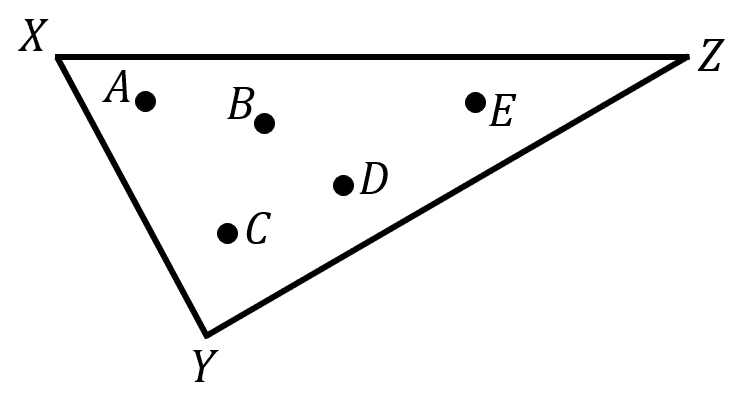
In the figure, point M is located at the midpoint of side XZ, and point N is located at the midpoint of side XY. Which lettered point is located on segment MN?
The steps are:
1: Mark the midpoint of side XZ and label it M.
2: Mark the midpoint of side XY and label it N.
3: Draw a line connecting M and N, and see which lettered point it passes through.
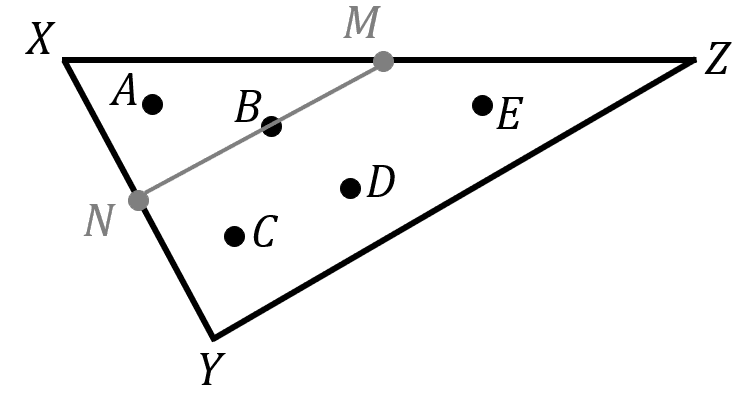
The answer is the point that falls on segment MN once it’s drawn — that’s point B. Notice that no calculation happens anywhere in this problem. The entire solution is translating the words “midpoint of XZ” and “midpoint of XY” into marks on the diagram.
A Trickier Setup: Midpoints on Two Separate Lines
The same method scales up to more complicated-looking figures. This version gives you two separate lines, each with three labeled points, where the middle point on each line is a midpoint.
Worked Sample Problem:
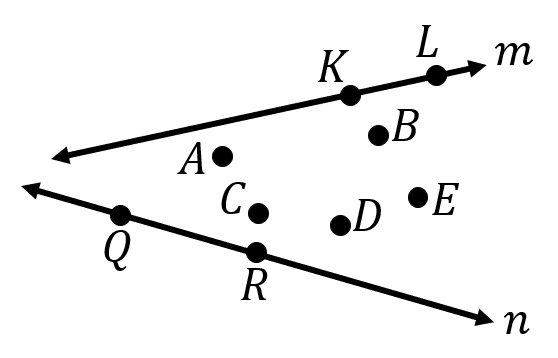
In the figure, points J, K, and L each lie on line m in that order, and points Q, R, and S each lie on line n in that order. If point K is the midpoint of segment JL, and point R is the midpoint of segment QS, then which lettered point will be located on the segment joining J and S?
The steps are:
1: Since K is the midpoint of JL, J and L sit on either side of K.
2: Since R is the midpoint of QS, Q and S sit on either side of R.
3: Draw a line connecting J and S, and see which lettered point it passes through.
The new line passes through point D. The setup looks more complicated than the first example, but both rely on the definition of a midpoint. In this case, the steps are to locate what you’re told is a midpoint, use that to place the surrounding points, and draw the segment the question is actually asking about.
When Midpoint Questions Get Weirder: Ordering Segments by Length
Occasionally the SSAT stretches the sketch-and-connect method further, asking students to compare several midpoint-based segments rather than just identify one point.
Worked Sample Problem:
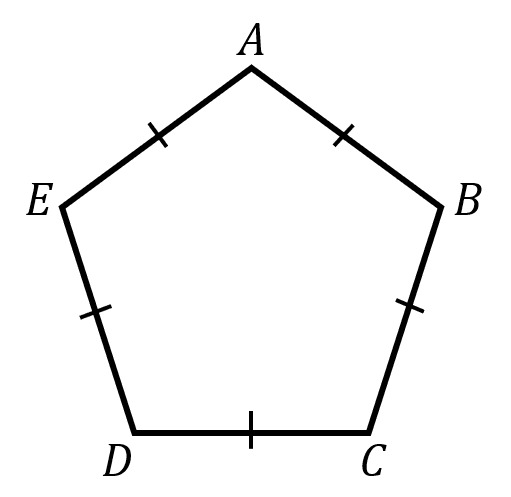
In the regular pentagon shown, point W is located at the midpoint of side ED, point X is located at the midpoint of side DC, point Y is located at the midpoint of side CB, and point Z is located at the midpoint of side BA. Which expression correctly orders the segments from shortest to longest?
(A) ZW < YW < XW
(B) ZX < ZW < ZY
(C) WX < WY < WB
(D) ZD < ZX < ZY
(E) It cannot be determined from the information given.
First, think about what the question is asking – each answer choice has segments in order from least to greatest. We will need to test which one is true.
Step 1: Label all three of the given midpoints on the pentagon.
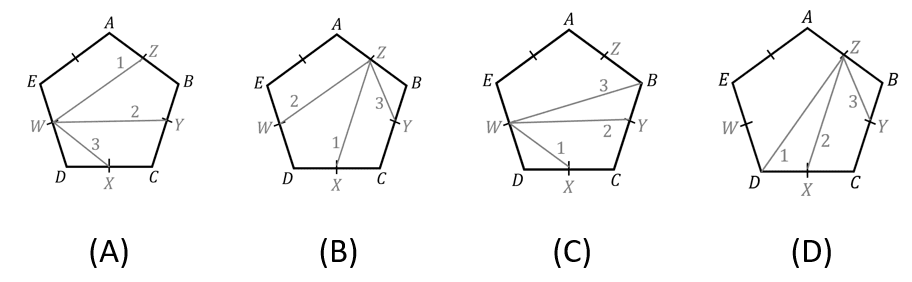
Step 2: Test each answer choice by sketching the three segments it describes, in order, directly on the figure. It helps to label the 1st segment 1, the 2nd 2, and the 3rd 3 to keep track of which one is supposed to be the shortest vs the longest. Because the answer choices orders each shortest to longest, we want the line labeled “1” to be shortest and “3” to be longest.
Step 3: Eliminate any choice where the segments clearly aren’t ordered shortest to longest once they’re drawn.
Working through the choices this way, only one holds up: the segments in choice C are genuinely ordered from shortest to longest, with WB — the segment cutting straight across the pentagon — coming in as the longest. The answer is C.
This question type looks intimidating because of the pentagon and the five answer choices, but it uses the exact same tool as the first two examples: mark the midpoints, sketch what’s being described, and let the diagram do the work instead of trying to reason it out in your head.
The Coordinate Plane Midpoint Formula (Good to Know, Rarely Needed)
Everything above involves plain geometric figures — no coordinate plane. Separately, Chapter 15: Linear Equations & Graphing covers midpoints between two points on the coordinate plane, which does use a formula:
The formula simply averages the x-coordinates and averages the y-coordinates.
Example: A segment has endpoints A (2, 4) and B (8, 6). \( \left( \dfrac{2+8}{2}, \dfrac{4+6}{2} \right) = (5, 5) \). The midpoint is (5, 5).
It’s worth having this formula memorized in case it comes up, but the large majority of SSAT midpoint questions are the diagram-based kind above, not this one. For more on coordinate geometry, see the coordinate geometry slope problems post.
Common Mistakes to Avoid
Trying to answer from the description alone. Every midpoint question above is solved by marking the figure and drawing what’s described — guessing without sketching is where most wrong answers come from.
Assuming “midpoint” means “somewhere near the middle.” A midpoint is exact. It splits a segment into two equal halves, not two roughly similar halves.
Overcomplicating the “which point” question type. These questions can look intimidating, especially with unfamiliar shapes like the pentagon example, but the method never changes: mark the midpoints, draw the connecting segment, and read the answer off the figure.
Reaching for the coordinate midpoint formula on a plain geometric figure. If the question gives you a figure with no coordinates, sketch it — the formula only applies when you’re given coordinate points.
Where This Fits in Your SSAT Prep
Midpoint problems are a small but recurring part of Chapter 8: Geometry — The Complete Picture, which covers every geometry topic on the SSAT Upper Level and makes up roughly 20–24% of the math section on its own. The geometry shortcuts post is also a good next stop.
For full SSAT Upper Level Math prep, the Complete Course walks through all 18 chapters – 545 pages covering nothing but SSAT Upper Level Math, written the way a tutor actually explains it, built from real experience working with 50+ SSAT students. If you’d like personalized help along with it, explore the book + tutoring packages.
If you’re not sure where to start, Kelly offers a free SSAT Upper Level Math diagnostic on her homepage. Take the diagnostic and you’ll know within an hour exactly which topics need the most attention.
Frequently Asked Questions: Midpoint Problems on the SSAT Upper Level
What is a midpoint on the SSAT Upper Level?
A midpoint is the point that cuts a line segment exactly in half, creating two segments of equal length. If C is the midpoint of segment AB, then AC and CB are always equal, regardless of how long AB is. Midpoint questions on the SSAT Upper Level appear mostly as plain geometric figures. Occasionally they may show up as coordinate points using the midpoint formula.
How do you find which point lies on a segment between two given midpoints?
Mark both given midpoints directly on the figure, draw the segment connecting them, and see which lettered point it passes through or comes closest to. This sketch-and-connect approach works even for more complex figures too. There can be multiple lines, unfamiliar shapes, or several midpoints at once, since the underlying process never changes.
Do SSAT midpoint questions usually require the midpoint formula?
No. Most SSAT Upper Level midpoint questions involve a plain geometric figure and are solved by sketching. The midpoint formula only applies to a smaller, separate question type that gives two coordinate points instead of a figure. It’s worth memorizing in case it comes up, but it isn’t the main skill being tested.
How is the coordinate plane midpoint formula different from geometric midpoint problems?
Geometric midpoint problems involve a plain figure with no coordinates. They’re solved by sketching the midpoints and reading the diagram. Coordinate plane midpoint problems give two coordinate points and ask for the point exactly between them, solved by averaging the x-coordinates and averaging the y-coordinates. They test a related idea but require completely different methods, and the coordinate version shows up far less often on the SSAT Upper Level.



Leave a Reply