How Do You Solve Distance-Rate-Time Problems on the SSAT?
To solve distance-rate-time problems on the SSAT Upper Level, pick the correct form of one relationship, Speed = Distance ÷ Time, based on what’s missing. Then plug in and solve. The setup is simple once a student sees which of the three quantities is missing. The real difficulty is the round-trip average-speed trap. Students average two speeds instead of dividing total distance by total time, and land on a plausible-looking wrong answer.
The short answer: Distance-rate-time problems all come from one relationship: Speed = Distance ÷ Time. Rearrange it depending on what’s missing: Distance = Speed × Time, or Time = Distance ÷ Speed. The setup itself is rarely hard. What trips students up is the average-speed trap in round-trip problems. Average speed equals total distance divided by total time. It is never the average of the two individual speeds.
What Are Distance-Rate-Time Problems, and Why Does the SSAT Test Them?
Distance-rate-time problems give two of three quantities, distance, speed, and time, and ask for the third. On their own, these problems are quick. The SSAT makes them interesting by wrapping the setup in a story, like a race, a commute, or a road trip. More often, it asks about a round trip or multi-leg journey with two different speeds.
These problems belong to the same family covered in Chapter 5 of Kelly Campbell’s book, Hacking the SSAT Upper Level Math: Shortcuts & Strategies for Every Question Type. That includes ratio and proportion problems and the work-rate setups covered in an earlier post. All three share the same underlying skill: recognizing which equation fits a given word problem.
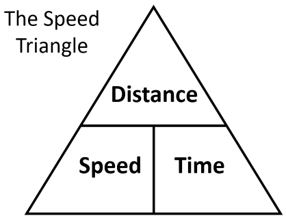
You can use this “Speed Triangle” to help you remember the 3 equations. Speed and time are next to each other, so they get multiplied when equal to distance. Distance is on top, so you can divide distance by either speed or time to get the other.
The 3 equations that come from this triangle are:
Speed = Distance ÷ Time (use when speed is missing)
Distance = Speed × Time (use when distance is missing)
Time = Distance ÷ Speed (use when time is missing)
Build this habit: before doing any arithmetic, identify which quantity the question is actually asking for. Then choose the matching form. Guessing at a formula and hoping the units work out wastes time and invites mistakes.
Worked Sample Problem: The Basic Setup
Astrid is traveling at 75 mph. At this rate, how many hours will it take her to drive 225 miles?
(A) 2
(B) 2.5
(C) 3
(D) 3.5
(E) 4
Step 1: Identify what’s missing. Speed and distance are given, time is missing, so use \( \text{Time} = \dfrac{\text{Distance}}{\text{Speed}} \).
That’s the easy version. The SSAT rarely stops there.
The Average-Speed Trap
When a problem describes a round trip, or a journey with two legs at two different speeds, the question usually asks for the average speed of the entire trip. The instinct is to average the two speeds. That instinct is wrong.
Average speed always equals total distance divided by total time. It is not the average of the two speeds. It isn’t even close in most cases, because the trip spends more time at the slower speed than the faster one.
Allison drives 90 miles to her destination at 45 miles per hour. She returns at 30 miles per hour. What is the average speed for her entire trip? (A) 35 (B) 36 (C) 37.5 (D) 38 (E) 40
Step 1: Find the time for each leg using \( \text{Time} = \dfrac{\text{Distance}}{\text{Speed}} \).
Simply averaging 45 and 30 gives 37.5, which is choice (C). That’s close enough to look correct on a multiple-choice test, but it’s still wrong. The real answer, 36 mph, is pulled toward the slower speed because the return trip took longer. Any time a round trip covers the same distance at two different speeds, the average leans toward the slower one. It never sits exactly in the middle.
Common Mistakes to Avoid
Averaging the two speeds directly. This is the single biggest error on distance-rate-time problems. Average speed depends on time spent at each speed, not just the speeds themselves.
Mismatched units. If speed is in miles per hour but distance is in feet, or time is in minutes, convert before plugging into the equation. This is the same unit-conversion habit covered in the Units & Ratios chapter.
Picking the wrong rearrangement. Solving for the wrong variable, or plugging distance into the time equation, is an easy slip under time pressure. Identify what’s missing first, every time, before writing an equation.
Forgetting a round trip means adding both legs. Total distance and total time both need every leg of the journey included, not just one direction.
Where This Fits in SSAT Math Prep
Distance-rate-time problems are one of several recurring word-problem types on the SSAT Upper Level. They reward students who recognize the setup instead of reinventing it mid-test. A student who has practiced the average-speed trap ahead of time won’t fall for the plausible-but-wrong answer choice sitting right next to the correct one.
Hacking the SSAT Upper Level Math: Shortcuts & Strategies for Every Question Type by Kelly Campbell covers distance-rate-time setups, including the average-speed trap, as part of Chapter 5.
For full SSAT Upper Level Math prep, the Complete Course walks through all 18 chapters – 545 pages covering nothing but SSAT Upper Level Math, written the way a tutor actually explains it, built from real experience working with 50+ SSAT students. If you’d like personalized help along with it, explore the book + tutoring packages.
If you’re not sure where to start, Kelly offers a free SSAT Upper Level Math diagnostic on her homepage. Take the diagnostic and you’ll know within an hour exactly which topics need the most attention.
Frequently Asked Questions: Distance-Rate-Time Problems on the SSAT
What is the pick-the-right-equation method for distance-rate-time problems?
It’s the habit of identifying which quantity, distance, speed, or time, is missing before choosing an equation. Then use the matching form: Speed = Distance ÷ Time, Distance = Speed × Time, or Time = Distance ÷ Speed. Choosing the equation first prevents the most common setup mistakes.
Is average speed the same as the average of two speeds?
No. Average speed always equals total distance divided by total time, not the arithmetic average of the two individual speeds. A trip spends more time at whichever speed is slower. That’s why the true average speed is always pulled toward the slower speed, rather than sitting exactly between the two.
How do you know when a distance-rate-time problem involves a round trip?
Look for language describing a trip out and a trip back, often at two different speeds, with a question asking for the average speed of the whole journey. That combination is the signal to find the time for each leg separately. Then add both distances and both times, and divide.
Do distance-rate-time problems always require unit conversion?
Not always, but check units before setting up the equation. If speed is given in miles per hour while distance or time appears in a different unit, convert first. Skipping this step is one of the most common ways to get a distance-rate-time problem wrong even with the correct setup.



Leave a Reply