You solve SSAT logic and counterexample problems by finding the “All X are Y” statement hidden in the question. Then test each answer choice to find an X that is not a Y. That single mismatched item is the counterexample, and it’s the correct answer. These questions usually include the word “prove” or “disprove.” Once you know what to look for, most of them take less than 30 seconds.
The short answer: SSAT logic questions ask which answer choice would prove a claim wrong. Find the claim’s “All X are Y” statement first. A true counterexample must satisfy X but fail Y. It has to belong to the category being described, while breaking the rule attached to it. Answer choices that don’t belong to the category at all can’t be counterexamples, no matter how unusual they look.
These questions describe a small collection of items, each with two or more characteristics. Then they present a claim about the collection. The claim always follows an “All X are Y” pattern, even when it’s phrased more naturally in the question. The question then asks which answer choice would prove the claim false.
This question type falls under symbols and puzzles, one of the unusual categories in Chapter 11 of Kelly Campbell’s SSAT Upper Level prep book. Like the SSAT’s symbol problems, logic questions look unfamiliar at first. But the pattern repeats every time. Once you’ve seen it a few times, the “prove” wording becomes a signal rather than a source of confusion.
Find the “All X Are Y” Statement
Start by locating the specific claim the question wants you to disprove. SSAT logic problems will always have an “All X are Y” statement. It will always describe one category (X) and assign it a single characteristic (Y). Once you’ve identified X and Y, test each answer choice by asking: is this item an X? If yes, does it fail to be a Y? Only an answer choice that passes both checks is a counterexample.
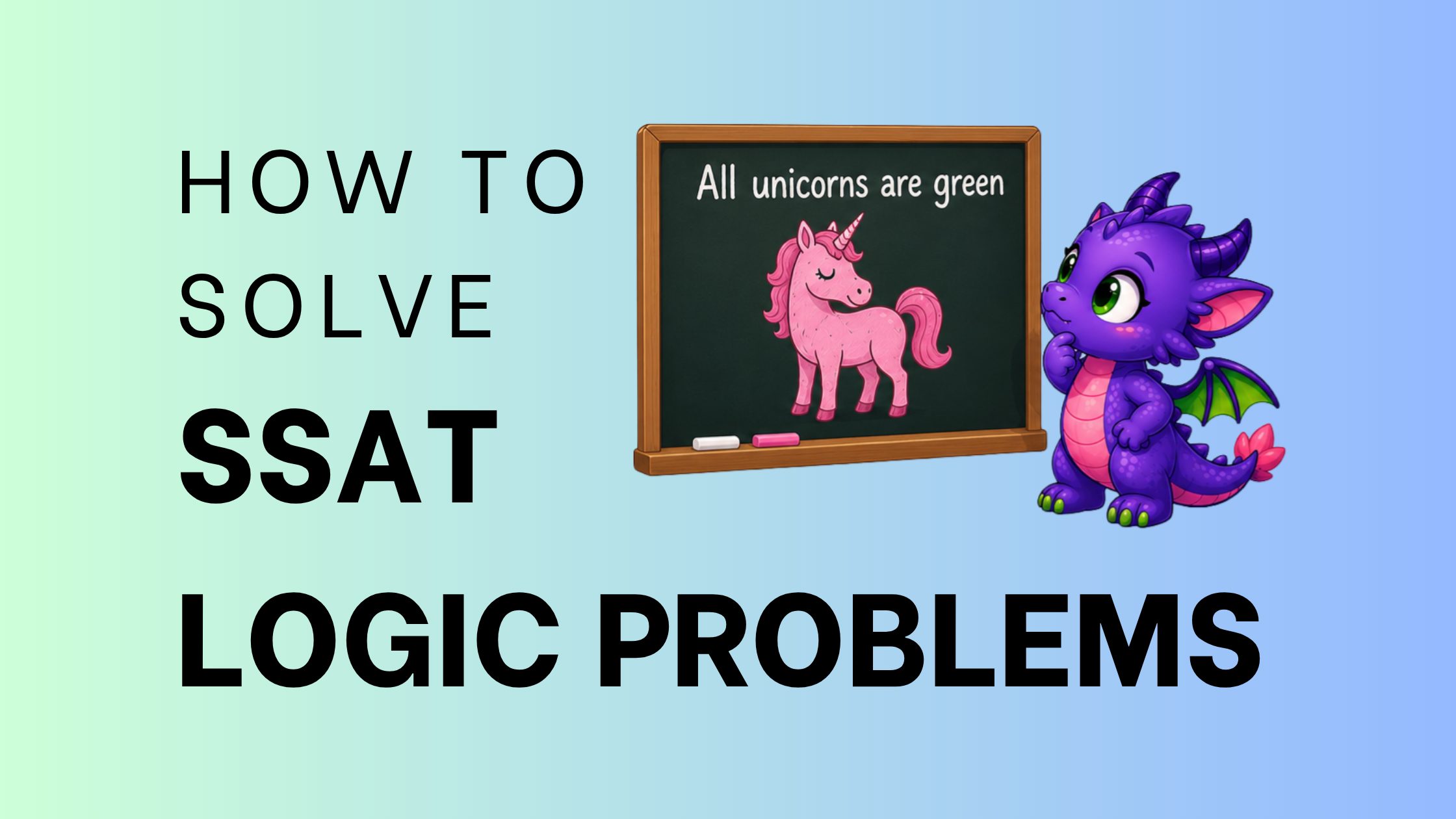
For example, in the image above, it says, “All unicorns are green.” X is being a unicorn, and Y is being green. A pink unicorn would disprove that statement because it IS a unicorn, AND it is NOT green.
An answer choice that isn’t a unicorn can’t prove anything, even if it is not green. That’s the detail most students miss under time pressure. It’s usually what makes three or four of the five answer choices easy to eliminate at a glance.
Worked Sample Problem
In Hue’s figurine collection, all of her figurines are made of either jade, wood, or metal. She only collects figurines that are cats, elephants, or monkeys. If Hue tells you that all of her monkey figurines are made of wood, the presence of which of the following figurines in her collection would prove her wrong?
(A) A wooden elephant
(B) A wooden cat
(C) A jade monkey
(D) A jade cat
(E) A metal elephant
Step 1: Identify the “All X are Y” statement. Here, X is “monkey figurines” and Y is “made of wood.”
Step 2: Test each answer choice by asking whether it’s an X (a monkey) that fails to be a Y (wood).
(A) A wooden elephant is not a monkey, so it can’t be a counterexample, even though “elephant” feels different from “monkey.”
(B) A wooden cat is also not a monkey.
(C) A jade monkey is a monkey, and it’s made of jade, not wood. → This is a monkey that isn’t wood.
(D) A jade cat is not a monkey.
(E) A metal elephant is not a monkey.
Step 3: Only one answer choice is both a monkey and not wood.
The answer is (C) A jade monkey.
More Practice: Two More Examples
The same method holds up across completely different setups. Here are two more, worked the same way.
Tati’s Postcards
Tati has a collection of postcards from Spain, Portugal, and France. All of her postcards are either of landscapes, cartoons, or collages. If Tati tells you that all of her postcards from Spain are cartoons, the presence of which postcard in her collection would prove her wrong?
(A) A cartoon postcard from France
(B) A landscape postcard from Spain
(C) A collage postcard from France
(D) A collage postcard from Portugal
(E) A cartoon postcard from Portugal
Here, X is “postcards from Spain” and Y is “cartoons.” Choices (A), (C), (D), and (E) all fail the X test first. None of them are from Spain. Only (B) is both from Spain and not a cartoon. The answer is (B).
Mateo’s Trophies
Mateo has a collection of trophies for soccer, swimming, and track. Each trophy is gold, silver, or bronze. If Mateo tells you that all of his swimming trophies are gold, which of the following would prove him wrong?
(A) A gold soccer trophy
(B) A silver swimming trophy
(C) A bronze soccer trophy
(D) A gold track trophy
(E) A silver track trophy
X is “swimming trophies” and Y is “gold.” Choices (A), (C), (D), and (E) aren’t swimming trophies at all. None of them can prove the claim wrong. Only (B) is a swimming trophy that isn’t gold. The answer is (B).
Common Mistakes to Avoid
The most common mistake in SSAT logic problems is picking an answer choice just because it looks unusual, without checking whether it belongs to the category at all. A jade elephant might feel like a good counterexample to “all monkeys are wood,” but it isn’t a monkey. It doesn’t prove anything.
A second mistake is misreading which part of the sentence is X and which is Y. Reread the claim slowly. Identify the category first (All ___), then the characteristic attached to it (are ___), before looking at any answer choices. If it is worded “All silver trophies are for track,” then silver is X and track is Y. We would look at the answer choices for a silver trophy that is for something other than track.
A third mistake is stopping as soon as one answer choice seems to fit, without checking that it satisfies both conditions. A correct counterexample always belongs to the category and breaks the rule. Missing either half means it isn’t the answer, no matter how tempting it looks.
Where This Fits Into SSAT Prep
Logic and counterexample questions are a small slice of the SSAT Upper Level. But they show up alongside other unusual formats covered together in Chapter 11: symbols, letters for digits, and how many groups problems.
For full SSAT Upper Level Math prep, the Complete Course walks through all 18 chapters – 545 pages covering nothing but SSAT Upper Level Math, written the way a tutor actually explains it, built from real experience working with 50+ SSAT students. If you’d like personalized help along with it, explore the book + tutoring packages.
If you’re not sure where to start, Kelly offers a free SSAT Upper Level Math diagnostic on her homepage. Take the diagnostic and you’ll know within an hour exactly which topics need the most attention.
Frequently Asked Questions: Logic and Counterexample Problems on the SSAT
What is a counterexample on the SSAT?
A counterexample is an answer choice that proves a stated claim false. On the SSAT, this means finding an item that belongs to the category the claim describes. That item also has to lack the characteristic the claim assigns to it.
How do you find the “All X are Y” statement in an SSAT logic problem?
Reread the claim in the question and identify the category being described, which is X. Then find the single characteristic assigned to every member of that category, which is Y. The claim is usually phrased naturally rather than literally as “all X are Y.” It helps to restate it that way in your own words before checking answer choices.
Why can’t an answer choice be a counterexample if it isn’t part of the category?
A counterexample has to directly contradict the claim, and the claim only makes a promise about members of category X. An item outside that category was never covered by the claim in the first place. It can’t prove anything about it, even if it looks different from Y in some other way.
How often do logic and counterexample questions appear on the SSAT Upper Level?
They’re an uncommon question type, appearing far less often than topics like fractions, geometry, or algebra. Even so, recognizing the “prove” wording immediately means a student won’t waste time figuring out what the question is asking on test day.



Leave a Reply